Sports
Super Bowl vs. FIFA World Cup: Which Sporting Event Is Actually Bigger?
As FIFA World Cup 2026 kicks off across the United States, Canada, and Mexico, the numbers settle one of sport's greatest debates — and the answer might surprise American fans
By CM News Desk | June 6, 2026
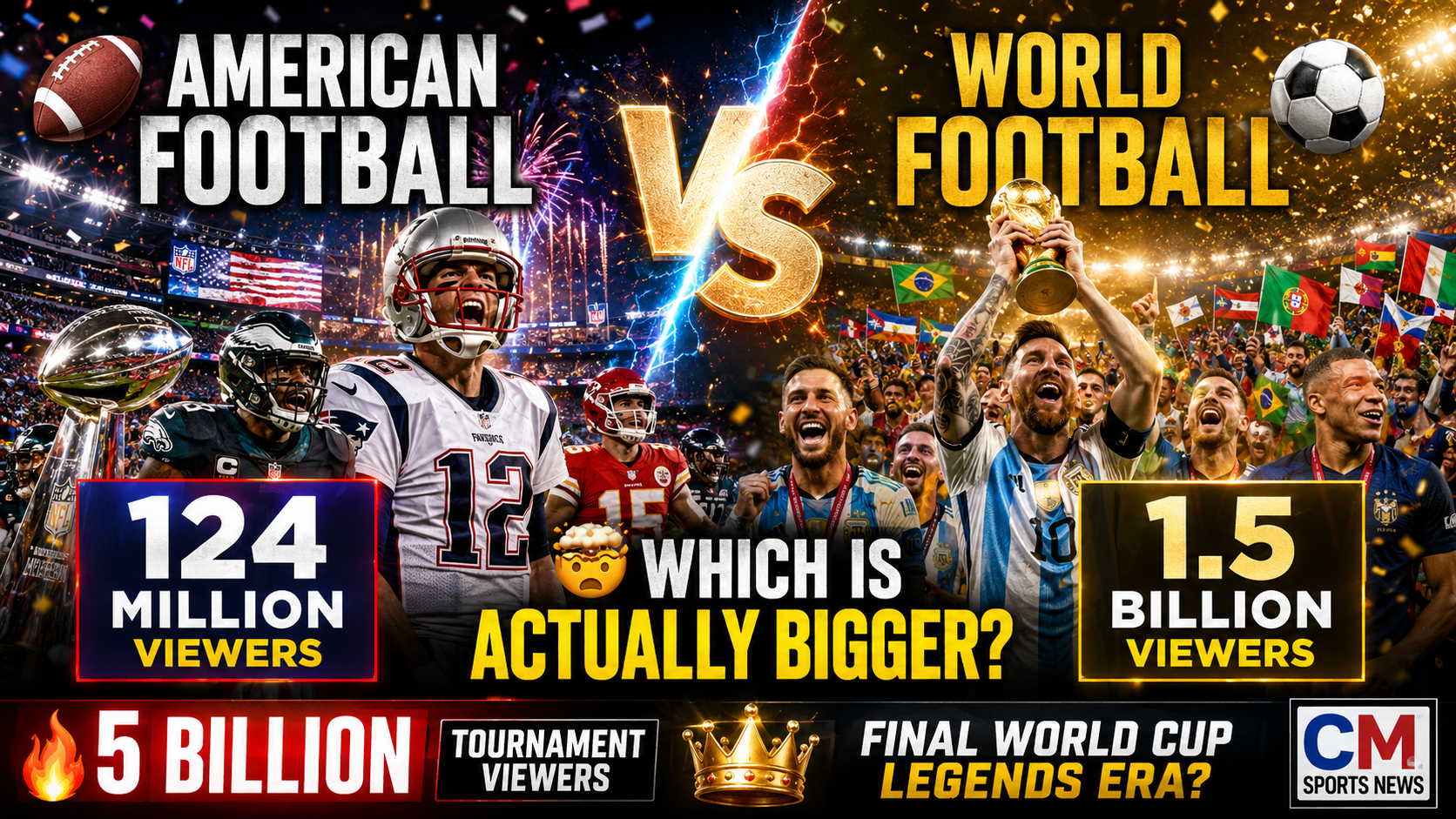
It is one of sport's most debated questions: which event is truly bigger — America's Super Bowl or the FIFA World Cup? Both attract enormous audiences, generate billions in revenue, and command global attention. But when the raw numbers are laid out side by side, the answer is clear — and the margin is not even close. With the 2026 FIFA World Cup now underway across the United States, Canada, and Mexico, the conversation has never been more relevant.
Key Facts
- The 2022 FIFA World Cup Final drew an average live audience of 571 million viewers globally, with over 1.5 billion watching at least one minute of the match
- Super Bowl LX in February 2026 averaged 124.93 million viewers — the second-most-watched show in U.S. TV history
- FIFA estimates 5–6 billion people tuned into the entire 2022 World Cup tournament across all matches
- FIFA President Gianni Infantino described the World Cup as "104 Super Bowls in one month"
- The 2026 World Cup features 48 teams and 104 matches across 16 cities in three host nations
The Numbers: Super Bowl 2026
The Super Bowl is, without question, America's biggest sporting event — and one of the most-watched annual broadcasts anywhere in the world. Super Bowl LX in February 2026 averaged 124.93 million viewers across NBC, Peacock, Telemundo, and NFL digital properties, making it the second-most-watched show in U.S. television history, just behind the 2025 Super Bowl's record of 127.71 million viewers. [Digital Journal]
Those are genuinely extraordinary numbers. For context, very few television events anywhere in the world consistently attract audiences above 100 million in a single country. The Super Bowl does it every year.
But it is, fundamentally, an American event. The vast majority of its audience is domestic.
The Numbers: FIFA World Cup
The World Cup operates at an entirely different scale — not just bigger, but categorically different in its global footprint.
The FIFA World Cup is the most-watched sporting event on the planet — nothing else comes close. In 2022, the final between Argentina and France pulled in a staggering 1.5 billion viewers worldwide, and across the entire tournament, FIFA estimates that around five billion people tuned in at some point — more than the Olympic Games, more than the Super Bowl, and more than any other global sporting spectacle. [Semrush]
By comparison, the 2022 World Cup Final alone reached an average live audience of 571 million viewers, with more than 1.4 billion people watching at least one minute of the dramatic 120-minute contest — a figure that dwarfs the Super Bowl's combined domestic and international audience. [Stackmatix]
FIFA's Own Verdict: "104 Super Bowls"
FIFA President Gianni Infantino has addressed this comparison directly and emphatically. Speaking to FOX Sports, Infantino noted that the World Cup's global viewership is equivalent to 104 Super Bowls compressed into one month. "Look at the Super Bowl, which is fantastic — it has what, 120, 130 million viewers? The World Cup has 6 billion viewers over a month of matches. So a World Cup is 104 Super Bowls in a month — which is three Super Bowls a day," he said. [Semrush]
That framing — three Super Bowls every single day for a month — captures the scale difference more vividly than any bar chart.
---
**The U.S. Picture: A Different Story**
There is one important nuance. Inside the United States specifically, the Super Bowl still reigns supreme.
Although the NFL and the Super Bowl continue to hold the top ratings spot in the U.S., overall World Cup viewership dwarfs that of American football globally. [Stackmatix](https://www.stackmatix.com/blog/facebook-ads-cost-complete-guide)
A February 2026 survey by consumer data firm Numerator found that 69% of U.S. consumers planned to watch Super Bowl LX, while just 26% planned to watch the FIFA World Cup — though the firm noted that planned viewership for the World Cup would likely rise significantly before the tournament began in June. [Sprout Social]
The 2026 World Cup, however, may change that domestic dynamic permanently. For the first time since 1994, the United States is a co-host — and with 48 teams, 104 matches, and home-nation participation by the U.S., Canada, and Mexico, the tournament is positioned to capture American audiences like never before.
Why 2026 Could Break Every Record
With the 2026 World Cup taking place across the United States, Canada, and Mexico — and featuring a record 48 teams — audience figures are expected to climb even higher. A larger field, three host nations, friendlier broadcast windows for audiences in the Americas, and a growing soccer culture in the U.S. all point toward record-breaking global viewership. [Semrush]
Lionel Messi's presence alone — playing what is widely expected to be his final World Cup — will attract billions of viewers who may not ordinarily follow the sport. Add the commercial power of three host nations, a booming Latino fan base in the United States, and FIFA's expanding broadcast deals, and the 2026 World Cup has every ingredient to become the most-watched sporting event in human history.
Revenue: Another Layer of the Debate
Beyond viewership, both events generate enormous commercial revenue — but the World Cup's longer duration and global sponsorship base give it a structural advantage. The Super Bowl generates the majority of its revenue in a single broadcast window; the World Cup generates sustained revenue across a full month of matches, broadcast rights in nearly every country on Earth, and in-person attendance from an international audience.
Conclusion
The verdict is unambiguous: by every global metric — total viewers, cumulative audience, international reach, and cultural footprint — the FIFA World Cup is the bigger event. The Super Bowl is the dominant force within the United States, and it is one of the most impressive annual broadcasts in the history of television. But the World Cup is a once-every-four-years phenomenon watched by half the planet. As the 2026 tournament gets underway on American soil, both events are entering a new era of competition for the title of sport's greatest stage — and the answer to the question "which is bigger?" may, for the first time, begin to shift even among American audiences.
Follow CM NEWS for live FIFA World Cup 2026 coverage including match results, player features, and breaking tournament news at [celebsammedia.com]