Technology
Samsung's Secret R&D Playbook: The Patents Revealing What the Tech Giant Is Building Next
Samsung Is Quietly Patenting the Future — Here Is What the Filings Reveal
By CM News Technology Desk | CelebSamMedia.com | Published: June 8, 2026
Samsung Electronics, the South Korean technology conglomerate that pioneered mass-market foldable smartphones, has been quietly filing patents for a sweeping range of next-generation devices — from augmented reality glasses and smart contact lenses to rollable phones, tri-fold displays, wrist-wrapping screens, and projector-equipped smartwatches. While most of these concepts remain in the research and development phase with no confirmed launch dates, the breadth of Samsung's patent portfolio offers a rare window into the company's long-term hardware ambitions.
Patent filings do not guarantee finished products. They represent ideas that companies protect to prevent competitors from blocking future development. Still, for Samsung — a company that turned years of foldable-phone patents into the bestselling Galaxy Z Fold and Z Flip lines — the filings carry real weight. The Galaxy Ring, Samsung's smart ring wearable, is the clearest example: after years of patent speculation, the device reached consumers in July 2024 and became one of the most talked-about wearables of the year.
Key Facts
- Who: Samsung Electronics, based in Suwon, South Korea
- What: A wide range of filed patents covering AR glasses, smart contact lenses, rollable and tri-fold phones, projector watches, wraparound displays, and more
- When: Patents filed across multiple years; several approved or published between 2023 and 2025
- Where: Filings submitted to the USPTO (United States Patent and Trademark Office), KIPRIS (Korea Intellectual Property Rights Information Service), European Patent Office, and the UK Intellectual Property Office
- Why it matters: The filings signal Samsung's strategy to diversify beyond traditional smartphones and compete in the emerging wearables and extended reality (XR) markets
A Closer Look at Samsung's Most Ambitious Patents
Augmented Reality Glasses
Samsung has filed and received approval for multiple AR glasses patents over several years. One notable filing, published in late 2024, describes a pair of streamlined glasses featuring a "grouping" function — a shared AR network that would allow multiple wearers to interact within the same virtual environment. Industry analysts have suggested this could open doors for multiplayer gaming, collaborative workspaces, and live events.
A separate patent published in November 2025 under the designation US 2025/0347929 A1 describes smart glasses with an adjustable hinge system designed to fit different head sizes — a detail that points toward consumer comfort as a development priority, not just raw technical capability.
Reports from Shenzhen-based research firm Wellsen XR, published in late 2024, went further: the firm claimed Samsung had confirmed plans to produce AI-powered smart glasses in the third quarter of 2025, with an initial production run of 500,000 units. The glasses were said to use Qualcomm's AR1 chip, a 12-megapixel Sony camera sensor, and would run Google's Gemini large language model in a joint development with Alphabet's Google. Samsung has not publicly confirmed these specifications.
Samsung Smart Contact Lens
Among the more futuristic entries in Samsung's patent portfolio is a smart contact lens equipped with a miniature display, a camera, an antenna, and sensors capable of detecting eye movement and blinks. The concept raises immediate questions about privacy, battery life, and biocompatibility — none of which the patent addresses in detail, as patents describe invention rather than engineering solutions. Nevertheless, the filing confirms that Samsung is at least conceptually exploring the most intimate form of wearable technology yet conceived.
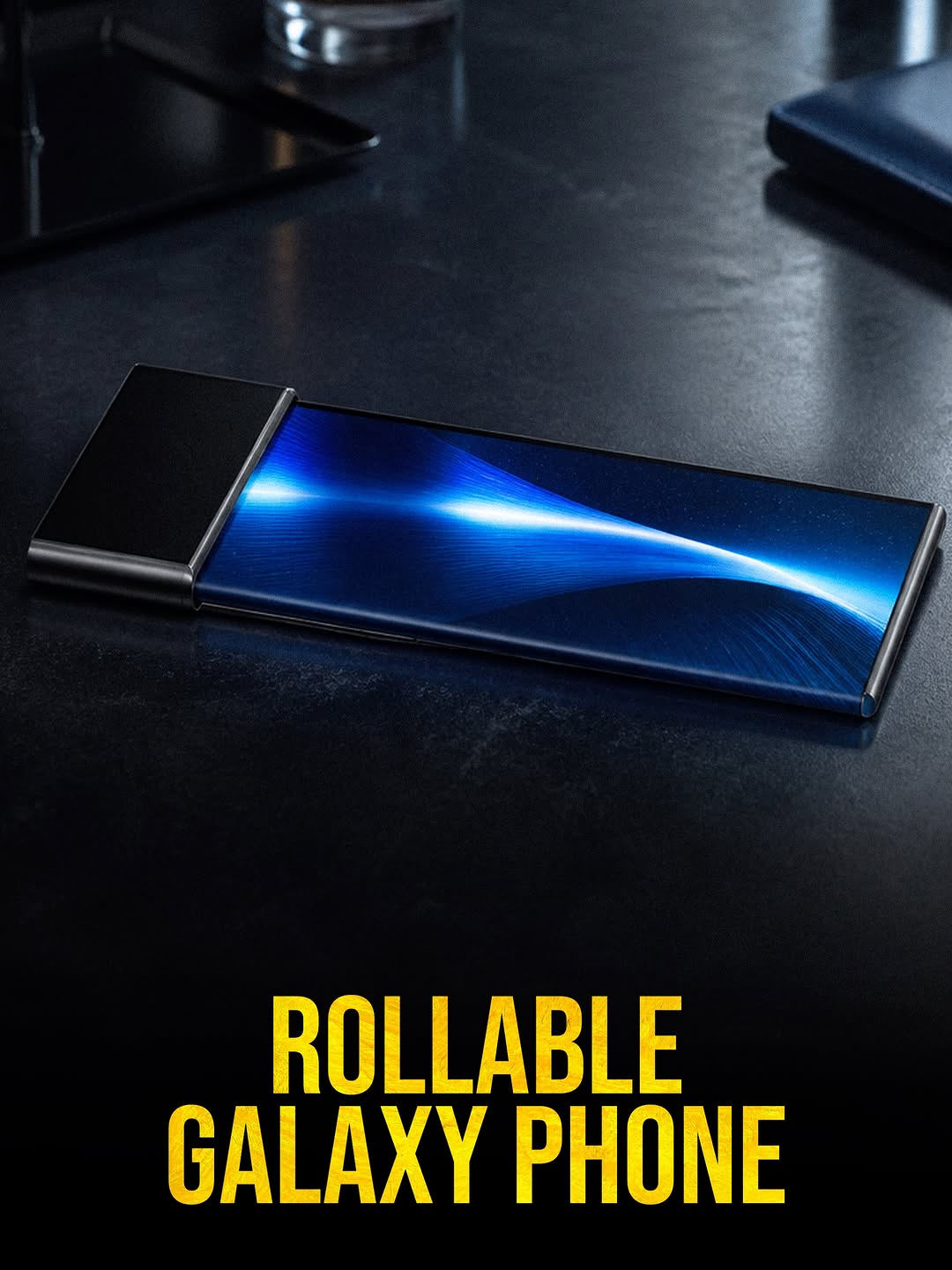
Rollable Galaxy Phone
Samsung first showcased its "Rollable Flex" concept at CES 2024, describing a phone with an expandable display capable of growing up to five times its original size. A subsequent patent, surfaced in mid-2025, showed a different rollable design: a device that slides horizontally, extending its display from right to left while keeping the camera module elevated. Reports in late 2024 suggested Samsung was pursuing a rollable phone with a fully extended 12.4-inch display, partly in response to Huawei's success with its own foldable technology.
Tri-Fold Smartphone
Samsung has been working on tri-fold smartphone concepts since at least 2014, with patents filed in 2014, 2021, 2023, and 2025. A patent approved in November 2024 — originally filed in July 2021 — focused on engineering solutions for display durability in a three-panel device, including adhesive layers, stainless steel support plates, anti-reflective coatings, and particle shielding systems. Samsung was beaten to market on this form factor by Huawei, whose Mate XT Ultimate Design became the first commercially available tri-fold phone. Samsung has not confirmed a launch date for its own version, though its continued patent activity signals sustained commitment to the concept.
Galaxy Ring With a Display
Samsung's Galaxy Ring, launched commercially in July 2024, is a health-focused wearable with no screen. But recent patent activity suggests the company is exploring a next-generation ring with a built-in display — capable of showing health data, notifications, or interactive interfaces directly on the band. A patent filed in 2025 also described the Galaxy Ring working in synchronisation with a Galaxy Watch, allowing the two devices to share and cross-reference biometric data.
Galaxy Watch With a Projector
One of the more visually striking patents shows a Galaxy Watch concept equipped with a pico-projector capable of casting an interactive interface onto the back of the wearer's hand. The concept would effectively turn skin into a touchscreen — eliminating the need to look at a small wrist display and instead projecting a larger, navigable menu.
Phone That Wraps Around the Wrist
Samsung has also filed patents for a wraparound wrist display — a flexible phone that can be worn as a bracelet and unrolled flat for use as a conventional smartphone. The concept builds on flexible OLED display technology that Samsung has been developing for more than a decade and represents one of the most dramatic reimaginings of the smartphone form factor in the patent portfolio.
Samsung Flying Display Drone
Perhaps the most unconventional concept is a drone equipped with a large display panel — essentially a flying screen that can hover and reposition itself in a room, bringing media or information directly to a viewer without requiring a fixed TV or monitor.
Background: Why Samsung Files So Many Patents
Samsung is consistently one of the top five patent filers globally, alongside IBM, Qualcomm, Canon, and Apple. For large consumer electronics companies, patents serve multiple strategic purposes: they protect genuine R&D investments, they build leverage in cross-licensing negotiations with competitors, and they allow companies to stake out territory in emerging categories before committing to full product development.
Not every Samsung patent becomes a product. Many are filed as defensive measures or as insurance against future design directions that may never be commercially viable. The smart contact lens, for example, faces substantial regulatory and biological hurdles that no consumer electronics company has yet cleared. The projector watch faces miniaturisation and battery challenges that remain unsolved at scale.
The rollable phone and tri-fold categories, however, are different. Both form factors have been demonstrated in working prototypes by Samsung and its competitors, and both are likely candidates for commercial launches within the next several years as flexible display manufacturing costs continue to fall.
Samsung's Strategic Response to Market Pressure
Samsung's expansive patent activity comes at a commercially sensitive moment. Samsung Display reported in 2024 that foldable screen sales fell below projections, with the Galaxy Z Fold 6 and Galaxy Z Flip 6 underperforming expectations. The company simultaneously faced intensifying competition from Chinese manufacturers including Huawei, which captured global attention with the Mate XT tri-fold, and OnePlus, Oppo, and Xiaomi, which have expanded aggressively in foldable and wearable categories.
The patents signal that Samsung's response to this competitive pressure is innovation acceleration rather than retreat. The broader smart glasses and extended reality market is projected to grow significantly, with some analysts estimating the sector could reach $1.7 trillion by 2032, up from approximately $131 billion in 2024. That scale of opportunity explains why Samsung — alongside Apple, Meta, and Google — is investing aggressively in wearable computing research.
Samsung's partnership with Google on the Wear OS platform, and the reported collaboration on Gemini AI for smart glasses, suggests the company is not pursuing this roadmap alone. Combined hardware and software ecosystems have proven essential in wearables — as demonstrated by Apple's dominance in smartwatches — and Samsung appears to be building the same kind of integrated stack.
What Happens Next
The nearest-term product likely to emerge from Samsung's extended patent portfolio is the AI smart glasses. Multiple supply chain reports and industry analysts pointed to a potential 2025 or 2026 launch window, though no official announcement has been made at the time of publication.
The tri-fold smartphone is also widely expected to arrive within the next product cycle, as Samsung has acknowledged interest in the category and has filed new patents as recently as early 2025. A four-panel foldable concept was also revealed in a patent application filed in early 2025, suggesting development continues to advance beyond the tri-fold.
The wraparound wrist phone, projector watch, smart contact lens, and flying display drone remain longer-horizon concepts with no credible near-term launch reports.
Conclusion
Samsung's patent filings paint a picture of a company thinking well beyond the next smartphone cycle. From augmented reality glasses powered by Google's Gemini AI to rollable phones that expand into tablets, the South Korean technology giant is exploring a hardware future that looks fundamentally different from today's device landscape.
The critical distinction, as always, is between what Samsung is researching and what it is preparing to sell. The Galaxy Ring made that journey from patent to product. Most of the concepts catalogued in recent filings have not yet taken that step — but in the competitive and rapidly evolving consumer technology industry, the gap between concept and shelf is narrowing faster than ever.
For the latest developments in Samsung product launches and wearable technology, visit CelebSamMedia.com.
Sources: USPTO, KIPRIS, European Patent Office, Wellsen XR research note (November 2024), AndroidHeadlines, Android Central, SamMobile, Yanko Design, Patently Apple
Disclaimer: The concept images associated with this story
are AI-generated illustrations and do not represent official Samsung product renders or confirmed designs.