Technology
Sensor Intelligence for Agriculture: How NuaSense Is Building the Data Layer for Africa's Farms — and What It Means for the Rest of the World
In a maize field outside Nairobi, the most valuable piece of equipment isn't a tractor. It's a stainless-steel probe the size of a pen, buried 30 centimeters into the soil, quietly measuring moisture, temperature, and nutrient levels every fifteen minutes. It has no SIM card. It doesn't need Wi-Fi. And it will keep working, on a single battery, for the next two years.
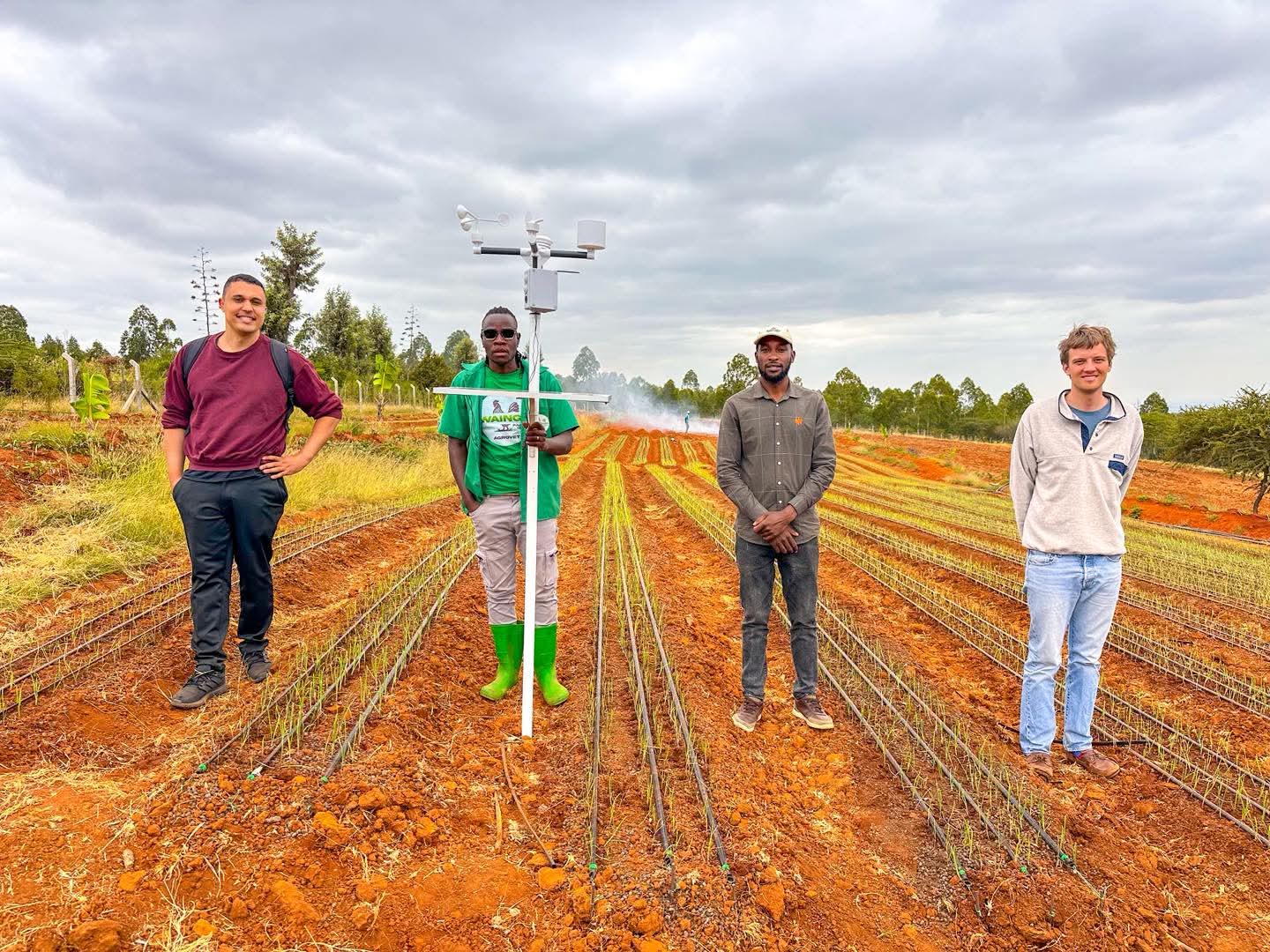
This is the quiet hardware at the center of NuaSense, a Nairobi-based agri-tech company building soil sensors and weather stations for farms across Kenya. The pitch is simple: stop guessing, start farming on data. But the implications reach well beyond one country's maize and bean fields. NuaSense is a case study in a much bigger global question — how do you bring precision agriculture to the roughly 500 million smallholder farmers worldwide who manage most of the planet's farmland but have been priced out of the technology that already transformed farming in wealthier regions?
The problem precision agriculture hasn't solved
Precision agriculture — using sensors, satellites, and analytics to apply water, fertilizer, and chemicals exactly where and when they're needed — is not a new idea. It has been reshaping commercial farming in North America and Europe for over a decade, and the economics are well established: industry data shows smart soil-sensor and irrigation platforms can cut water use by as much as 20%, and integrated systems often pay for themselves within two to four years.
The trouble is who that economics has worked for. The global precision-agriculture market is large and growing fast — projected to climb from roughly $18 billion in 2025 to over $50 billion by 2034 — but the value has concentrated overwhelmingly in large, capital-intensive farms with the infrastructure to support it: stable broadband, established dealer networks, and budgets that can absorb expensive hardware. Smallholders, who farm the majority of the world's agricultural land, have largely been locked out — not because the technology doesn't work for them, but because it wasn't built for their conditions.
Three barriers show up again and again in market research on this gap: cost, connectivity, and complexity. Sensor networks designed for thousand-acre American grain operations don't translate to a half-acre plot in western Kenya, a rice paddy in the Mekong Delta, or a coffee smallholding in the Colombian highlands. Different economics, different infrastructure, different everyday tools.
A different starting point
NuaSense was built around those constraints rather than against them. The company's two product lines — soil sensors and weather stations — are designed for exactly the environment most agri-tech ignores: farms without reliable Wi-Fi or grid power, run by people whose primary digital tool is a basic phone.
The soil sensor probes sit 10 to 60 centimeters underground and track three things simultaneously: volumetric soil moisture, temperature, and electrical conductivity — a proxy for salinity and nutrient levels that helps prevent both under- and over-fertilizing. The weather stations sit above ground and track wind speed and direction, temperature, humidity, atmospheric pressure, UV index, and rainfall, the kind of localized micro-climate data that a regional forecast simply cannot give a specific field.
What ties both product lines together is the connectivity layer: LoRaWAN, a long-range, low-power radio technology that moves small data packets over distances of up to 15 kilometers from a single gateway, on a battery that lasts more than two years (extended indefinitely where solar panels are fitted). No SIM card, no cellular bill, no dependence on broadband infrastructure that, across large swaths of rural Africa, Asia, and Latin America, simply isn't there.
It's a deliberate technology choice. The same precision-agriculture market reports that flag connectivity as a major adoption barrier also note that expanding LoRaWAN and NB-IoT coverage is one of the clearest ways to extend IoT into remote farming regions — exactly the gap NuaSense is built to fill.
Meeting farmers where they already are
Hardware is only half the story. A soil moisture reading is worthless if the farmer never sees it, or sees it in a form they can't act on. This is where NuaSense's second design decision matters as much as the LoRaWAN radio: the data goes out over dashboard, WhatsApp, and SMS — not just a web portal.
That choice reflects something specific about how mobile technology is actually used in markets like Kenya. Research into agricultural IoT adoption across the region consistently finds that platforms built around SMS, USSD, and WhatsApp achieve meaningfully higher engagement than web dashboards alone, and that short, clear alerts — "irrigate now," "frost risk tonight" — outperform detailed charts that require interpretation. A farmer doesn't need a graph of electrical conductivity trends. They need to know, today, whether to turn on the irrigation pump.
This is a pattern with relevance well beyond Kenya. Across most of the Global South, and in plenty of rural communities in wealthier countries too, mobile messaging is the dominant digital channel — more reliable, more familiar, and more universally accessible than a browser-based platform. Any sensor company trying to reach smallholders anywhere is going to run into the same design question NuaSense already answered.
The economics of "good enough"
The other thing that stands out about NuaSense's model is price. Weather stations start at KSh 20,000 (roughly $150), and soil sensors start at KSh 5,000 (roughly $39) — a fraction of the cost of commercial-grade precision-ag equipment built for large-scale operations elsewhere.
This isn't an accident of cheap manufacturing; it reflects a different theory of value. Market analysis of smallholder technology adoption consistently finds that affordability isn't just about sticker price — it's about durability, low maintenance, and predictable running costs over multiple seasons. A sensor that costs less upfront but fails after one season, or needs constant servicing, isn't actually cheaper. The 2-year battery life and solar-powered options in NuaSense's stations are direct responses to that math: even modest, incremental gains — a bit less wasted water, a slightly better-timed fertilizer application — are enough to justify the investment if the hardware keeps working reliably across seasons.
There's a broader lesson in this for sensor-intelligence companies anywhere trying to serve smaller producers: the win isn't squeezing more features into the box, it's squeezing more reliable seasons out of it.
Why this matters now
The timing is not incidental. Kenya's agricultural sector accounts for roughly 30% of GDP and the large majority of rural employment, and it is also acutely exposed to climate volatility — recurring droughts, erratic rainfall, and crop failures that have pushed millions into acute food insecurity in recent years. Agriculture across sub-Saharan Africa faces similar pressure: the IPCC has projected meaningful declines in regional crop productivity for staples like maize and wheat by mid-century if adaptation doesn't keep pace.
Climate adaptation research is fairly consistent on what helps: farmers who diversify crops, switch to drought-tolerant varieties, and manage water more deliberately see measurably better food security outcomes than those who don't. None of those strategies require a sensor. But all of them work better with real-time, field-specific data about what the soil and the sky are actually doing — rather than a regional forecast or a once-a-year soil test that's already months out of date by the time a decision needs to be made.
That's the gap NuaSense's products are aimed at closing: not just yield optimization in the abstract, but decision-quality information at the exact moments — planting, irrigating, fertilizing, spraying — when a wrong guess is costliest.
A model with global relevance
NuaSense operates in one country today, but the problem it's solving for is universal. Wherever farms are small, capital is limited, connectivity is patchy, and climate volatility is rising — which describes an enormous share of the world's agricultural land — the same three design choices apply: connectivity that doesn't depend on broadband, alerts that arrive through channels people already use, and hardware priced and built for multi-season reliability rather than maximum feature density.
Large-scale agri-tech, built around tractors with built-in telematics or satellite-driven analytics platforms, is solving precision agriculture for the top of the market — farms that already have capital, infrastructure, and scale. The harder, more consequential problem is building the same intelligence layer for the other half of the world's farmland: the half made up of half-acre plots, hand tools, and a single phone with intermittent signal. NuaSense's bet is that the underlying physics of soil moisture, EC, and microclimate doesn't change based on farm size — and that the company that solves connectivity and affordability for that segment first will have built something that travels far beyond Kenya's borders.
For now, the proof point is more modest and more concrete: a probe in the ground, a reading every fifteen minutes, and a WhatsApp message that tells a farmer whether to irrigate today or wait until tomorrow.