Technology
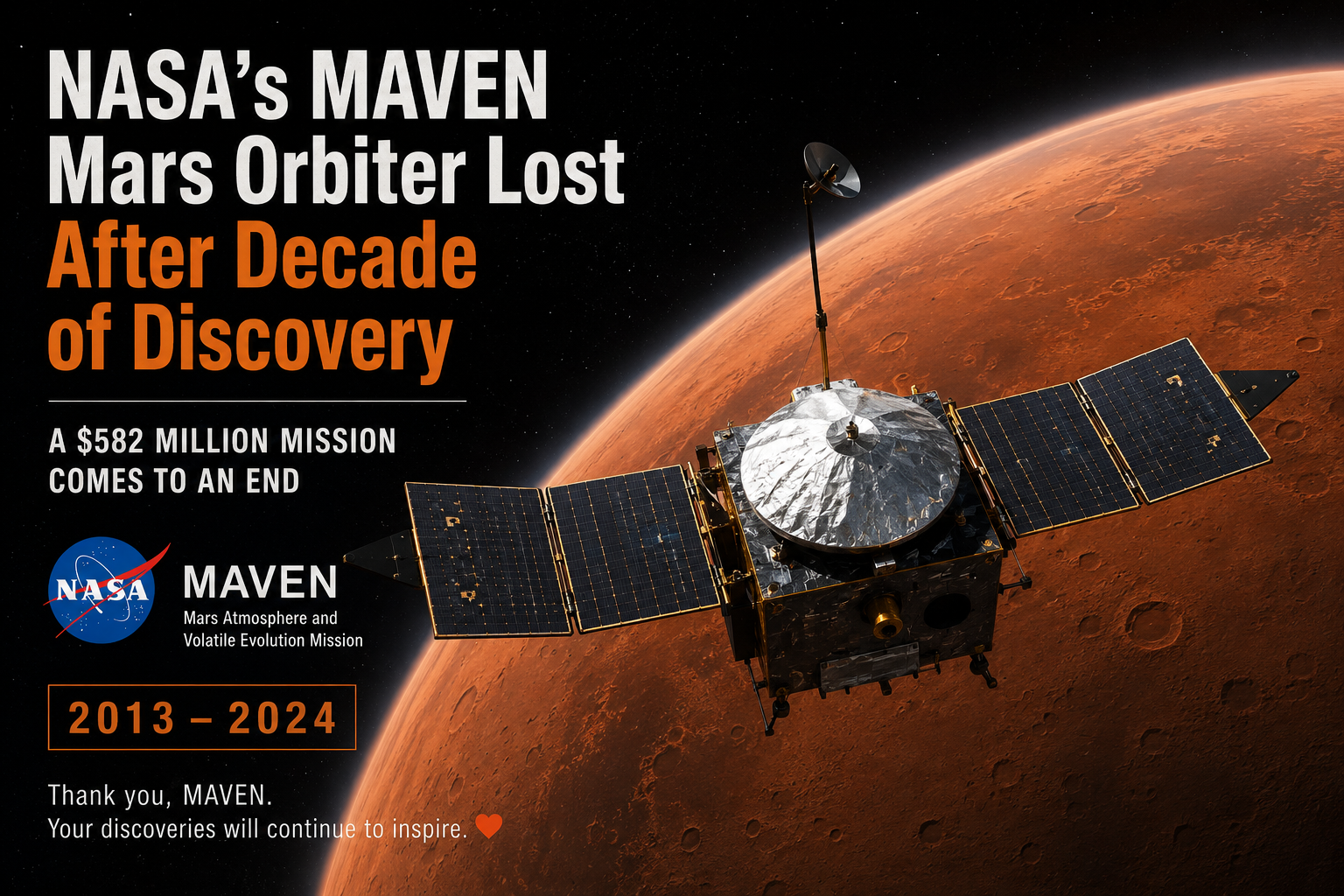
NASA's MAVEN Mars Orbiter Lost After Decade of Discovery — A $582 Million Mission Comes to an End
The MAVEN spacecraft, which spent over a decade studying the Martian atmosphere, has been declared unrecoverable following an unresolvable technical failure on the far side of Mars.
By CM NEWS Staff | June 5, 2026
NASA has officially declared the end of its MAVEN mission after engineers determined the spacecraft could not be recovered from a critical malfunction that occurred while the orbiter was out of direct communication range on the far side of Mars. The $582 million mission, which launched in 2013 and arrived at Mars in 2014, had far exceeded its original lifespan and produced groundbreaking scientific data about the Martian atmosphere and climate history.
Key Facts
- Mission cost: $582 million
- Launch date: November 2013
- Mars orbit insertion: September 2014
- Mission end declared: June 2026
- Cause: Unrecoverable technical failure on the far side of Mars
- Operating agency: NASA's Goddard Space Flight Center
NASA officials confirmed this week that the Mars Atmosphere and Volatile Evolution spacecraft — known as MAVEN — has reached the end of its operational life after an unspecified technical problem occurred while the orbiter was positioned on the far side of Mars, beyond the reach of ground-based communications.
When a spacecraft is on the far side of a planet, engineers on Earth lose direct signal contact for a period of time. During one such communications blackout, MAVEN experienced a failure that ground teams were ultimately unable to diagnose or resolve remotely. Despite extended recovery efforts, NASA determined that the spacecraft could not be brought back to operational status.
The agency confirmed the mission's conclusion in a statement this week, noting that while the loss is significant, MAVEN's scientific legacy remains intact and valuable.
Background: What Was MAVEN?
MAVEN was designed with a specific and ambitious scientific purpose — to investigate how Mars lost most of its atmosphere billions of years ago, transforming from a potentially habitable world into the cold, barren planet it is today.
Unlike Mars rovers such as Curiosity or Perseverance, MAVEN never landed on the Martian surface. Instead, it operated in orbit, dipping periodically into the upper atmosphere to collect direct measurements of atmospheric particles, solar wind interactions, and magnetic field data.
Over more than a decade of operations, MAVEN helped scientists understand the role the sun plays in stripping planetary atmospheres through a process called solar wind erosion. Its data contributed directly to the theory that Mars once had a thicker atmosphere capable of supporting liquid water — and possibly life.
MAVEN also served a secondary operational role, acting as a communications relay for surface missions including NASA's Curiosity rover and the InSight lander.
Analysis: Why This Mission Matters
The loss of MAVEN closes an important chapter in NASA's Mars Exploration Program, but the spacecraft's contributions will continue to shape planetary science for years to come.
Among its most significant findings, MAVEN confirmed that the sun's ultraviolet radiation and solar wind have been steadily stripping ions from the Martian upper atmosphere for billions of years. Scientists estimate Mars is losing roughly 100 grams of atmosphere per second — a rate that, over geological timescales, accounts for the near-total loss of its once substantial atmosphere.
This research has direct implications for the broader search for life beyond Earth. Understanding why Mars lost its atmosphere helps scientists identify which exoplanets in other solar systems might retain conditions capable of sustaining life.
Dr. Shannon Curry, who served as MAVEN's principal investigator, previously described the mission as transformative in the field of comparative planetology — the study of how different planets evolve over time. MAVEN's decade-long data set gives researchers a long-term baseline that short-duration missions cannot provide.
What Happens Next
With MAVEN no longer operational, NASA's active assets at Mars now include the Curiosity rover, the Perseverance rover, and the Ingenuity helicopter — though Ingenuity itself ceased operations in early 2024 after a rotor blade was damaged.
The Mars Reconnaissance Orbiter (MRO), launched in 2005, continues to function and will absorb some of the relay communication duties previously handled by MAVEN.
NASA's long-term Mars program includes continued surface exploration, planned sample return missions in cooperation with the European Space Agency, and eventual crewed missions to Mars that are currently in early planning stages under the agency's Moon to Mars architecture.
The loss of MAVEN adds urgency to discussions within NASA about the aging fleet of Mars orbiters and the need for next-generation atmospheric science missions to maintain continuous study of the Martian environment.
Conclusion
MAVEN's end marks the close of one of NASA's most scientifically productive interplanetary missions. Launched over a decade ago on a focused mission to understand Mars's atmospheric past, the spacecraft ultimately delivered far more than its original mandate required. While its loss is a setback for ongoing Mars science, the data it collected will remain a cornerstone of planetary research for decades. NASA has not yet announced a successor mission specifically tasked with atmospheric monitoring at Mars.
For more space and science coverage, follow CM NEWS.