Technology
Inside Africa's First Automated Underground Waste System: How Konza Technopolis Is Redefining Smart City Living
Commissioned by President William Ruto in October 2025 and valued at KSh 1.1 billion, Konza's pneumatic waste collection system is a landmark achievement in African urban innovation — and a signal of what smart cities on the continent can look like.
Byline: CM News Technology & Urban Affairs Desk | Date: June 4, 2026
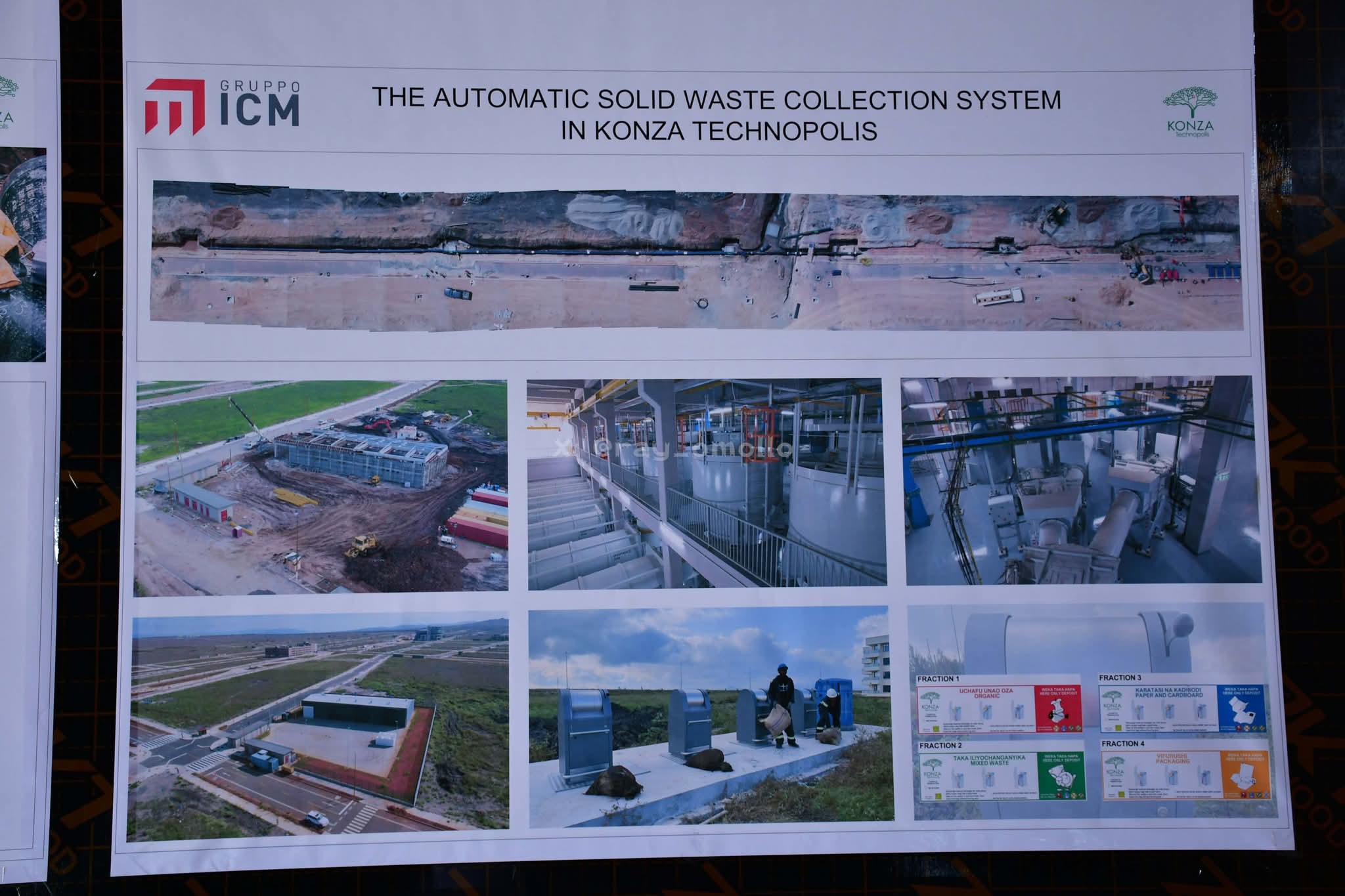
Kenya's Konza Technopolis has taken a defining step in Africa's smart city revolution with the full operationalisation of the continent's first automated pneumatic solid waste management system. Officially commissioned by President William Samoei Ruto on October 13, 2025 — as part of the broader inauguration of Konza's Phase 1 infrastructure — the system eliminates conventional garbage trucks in favour of a sophisticated underground vacuum network capable of processing up to 40 tonnes of solid waste every single day. The development, delivered by global environmental technology leader Envac and constructed by Italian firm ICM S.p.A., has placed Konza firmly at the forefront of sustainable urban infrastructure across Africa and the developing world.
Key Facts
- Project value: Approximately KSh 1.1 billion (€8 million)
- System supplier: Envac (global environmental technology leader)
- Construction partner: ICM S.p.A. (Italy)
- Commissioned by: President William Samoei Ruto, October 13, 2025
- Underground pipeline: 14.8 kilometres linking East and West Konza
- Collection stations: 25, with 100 disposal inlets
- Daily waste capacity: Up to 40 tonnes
- Transport speed: Waste travels through pipes at up to 70 km/h
- Waste categories: Organic, paper, packaging, and mixed waste
- Monitoring system: Centralised SCADA platform with automated vacuum activation
- Separation technology: Advanced cyclone separation at central terminal
- Phase 1 population: Designed to serve approximately 30,000 residents
- Location: Konza Technopolis, approximately 60 kilometres southeast of Nairobi
When President Ruto stood at Konza Technopolis on October 13, 2025 to commission Phase 1 of what Kenya calls its "Silicon Savannah," he was inaugurating far more than roads and fibre optic cables. Among the suite of world-class infrastructure activated that day was a piece of engineering that has no precedent anywhere else on the African continent — a fully automated, underground pneumatic waste collection system that has fundamentally changed how a city handles its rubbish.
The system was delivered by global environmental technology leader Envac and is valued at an estimated KSh 1.1 billion (€8 million). [ The Star ] It was implemented through Italian construction firm ICM S.p.A. as part of Konza's commitment to building a smart, clean, and efficient city. [ The Standard ]
The scale of the infrastructure is considerable. A 14.8-kilometre underground pipeline network connects 25 collection stations with 100 disposal inlets distributed across East and West Konza. Key features include 880 automated valves and 220 additional disposal points. [The Star] Residents and businesses sort waste at source into four categories — organic, paper, packaging, and mixed waste — before the system takes over entirely.
How the Technology Works
The operational mechanics of the system represent a significant departure from conventional waste management. Rather than relying on garbage trucks, collection schedules, and the associated noise, odour, and carbon emissions, Konza's system functions as an always-available underground utility — more akin to water or electricity than to traditional rubbish collection.
Operations are managed through a centralised SCADA (Supervisory Control and Data Acquisition) platform that continuously monitors waste levels across all inlets. When collection thresholds are reached, the platform automatically activates high-powered vacuum technology, drawing waste through the underground pipelines at speeds of up to 70 kilometres per hour toward the central processing terminal.
At the terminal, advanced cyclone separation technology extracts solid waste for compaction and recycling, while filtered air is safely returned to the environment. The system operates approximately 6 to 7 hours daily, efficiently managing waste without causing disturbances such as noise, odour, or excessive truck traffic. [Envac]
The four waste streams — organic, mixed, plastics, and paper — are handled separately throughout the process, improving recycling efficiency and supporting Konza's broader vision of becoming a zero-emission, smart, and sustainable city. [The Star]
Background: Konza Technopolis and Kenya's Vision 2030
Konza Technopolis did not emerge overnight. The city is part of Kenya's Vision 2030 plan, which aims to create a world-class smart city with a robust ICT sector, dependable infrastructure, and a business-friendly environment — a government-initiated project dubbed "Africa's Silicon Savannah." [Tuko]
Located in Makueni County, approximately 60 kilometres from Nairobi, Konza has been in development for over a decade. The October 2025 Phase 1 commissioning was a major milestone. The Phase 1 infrastructure commissioned includes 40 kilometres of smart roads, 170 kilometres of water and drainage networks, 6 kilometres of utility tunnels carrying fibre optic cables, and a 120-megawatt gas-insulated smart power substation. [ Tuko ] The city also operates a Tier 3 National Data Centre and a Silicon Savannah Intelligent Operations Centre that monitors all city systems in real time.
The pneumatic waste system sits within this broader smart infrastructure framework as one of its most visible and internationally significant components.
When fully operational, Phase One will accommodate over 17,000 residents and workers, and Konza projects a contribution of up to 2 percent of Kenya's GDP once fully developed, driving growth across ICT, construction, real estate, and education. [TechJournal]
Security and Operational Continuity
The seamless operation of infrastructure of this complexity requires more than engineering. Kenya's State Department for Internal Security and National Administration plays an active role in supporting Konza's critical systems, coordinating public compliance frameworks, protecting essential utility corridors, and strengthening emergency response readiness around the automated waste network. This governance dimension reinforces Konza's status as not just a technological showcase, but a secure and operationally resilient urban environment — one in which innovation and institutional coordination work in concert.
Expert and Industry Reaction
The project has drawn significant attention from both domestic and international observers. Konza Technopolis CEO John Paul Okwiri described the system as a major milestone in sustainable urban development. "By integrating Envac's state-of-the-art waste management solution, the smart city aims to elevate the quality of life for residents while demonstrating global best practices in sustainable urban infrastructure," Okwiri said. [The Standard]
From the technology provider's side, Carlos Bernad, CEO of Envac Iberia and President of Envac EMEA, said the system would help improve essential services, boost recycling rates, reduce CO₂ emissions, and protect the environment for future generations. [Tuko]
The investment sets Konza Technopolis a notch higher in urban planning for Africa, showing how intelligent infrastructure can transform cities into hubs of innovation, sustainability, and well-being. [Tuko]
Analysis: What This Means for African Urbanism
Africa is the world's fastest urbanising continent. By 2050, it is projected to host six of the world's ten largest cities. Yet rapid urbanisation has historically been accompanied by overwhelmed infrastructure, inadequate sanitation, and mounting waste crises. Konza's pneumatic waste system offers a counternarrative — a proof of concept that African cities can leapfrog legacy infrastructure models entirely, adopting cutting-edge solutions rather than replicating the outdated systems of earlier industrialising nations.
The system's significance extends beyond Kenya. Cities across Sub-Saharan Africa, from Lagos to Dar es Salaam, are grappling with solid waste management challenges that cost billions of dollars annually and contribute to public health emergencies. Konza's deployment of Envac technology — the same firm that has delivered similar systems in Singapore, the United Arab Emirates, and across Europe — demonstrates that such solutions are viable in African contexts when the political will, funding, and governance frameworks are in place.
The Konza model also illustrates the value of public-private-international partnerships in closing Africa's infrastructure gap, combining Kenyan government vision, Italian construction expertise, and Swedish environmental technology into a single operational system.
What Happens Next
The system is designed to serve residents and commercial users in Phase 1 of Konza Technopolis, which will host approximately 30,000 residents. [The Standard] As subsequent phases of development are rolled out — including the planned 10,000-unit affordable housing project for which President Ruto laid the foundation stone in October 2025 — the waste management infrastructure will need to scale accordingly.
Konza's planners have built the system with that expansion in mind. With the SCADA monitoring platform providing real-time data on usage and capacity, future additions to the network can be integrated systematically as the city grows.
Internationally, the Konza system is already being closely watched as a reference model. The Technopolis was gazetted as an Export Processing Zone in August 2025 [TechJournal] , adding an investment incentive layer to its already compelling value proposition for global businesses and innovators.
Conclusion
Konza Technopolis's pneumatic waste management system is more than an engineering achievement — it is a statement of intent. It declares, concretely and operationally, that African cities are capable of setting global standards rather than following them. Commissioned by a sitting head of state, delivered through an international partnership, and now serving a growing smart city population, the system represents the kind of infrastructure leap that Kenya's Vision 2030 was designed to produce. As Africa urbanises at an unprecedented pace, Konza's underground network offers a model worth watching — and worth replicating.
Sources: The Standard, The Star, Tuko.co.ke, Envac Group, Ecofin Agency, Serrari Group, TechJournal Kenya