World
The World's 10 Most Peaceful Countries in 2026: Europe Dominates Global Peace Index Rankings
Iceland leads the world's most comprehensive annual peace ranking for the fifteenth consecutive year, as European nations claim eight of the top ten positions and Singapore stands as Asia's sole representative in the elite group
By CM NEWS World Affairs Desk Published: June 4, 2026
Europe has once again asserted its dominance as the world's most peaceful region, according to the latest Global Peace Index rankings, with eight of the top ten most peaceful nations on earth located on the continent. Iceland retains its position at the very top of the global ranking — a position it has held for well over a decade — while Ireland, New Zealand, Austria, Switzerland, Portugal, Denmark, Slovenia, and Finland complete a top ten that reflects the sustained strength of small and mid-sized democratic states in delivering peace, stability, and safety for their citizens.
Singapore stands as the sole Asian nation to break into the elite top ten, a distinction that underscores the city-state's exceptional governance record in a region where geopolitical tensions remain considerably more complex than in Europe.
KEY FACTS
- Iceland ranks first globally as the world's most peaceful country
- Eight of the top ten most peaceful nations are European
- Singapore is the only Asian country in the global top ten
- The full top ten: Iceland, Ireland, New Zealand, Austria, Switzerland, Singapore, Portugal, Denmark, Slovenia, Finland
- The Global Peace Index measures peace and safety as overlapping, interconnected strengths
- Small and mid-sized states dominate the top positions, reflecting a consistent historical pattern
- The ranking covers 163 independent nations and territories worldwide
THE FULL TOP TEN — COUNTRY BY COUNTRY
1. ICELAND — THE WORLD'S MOST PEACEFUL NATION
Iceland's position at the summit of the global peace ranking is one of the most consistent records in international affairs. The North Atlantic island nation of approximately 370,000 people has held the top position on the Global Peace Index for the majority of the index's existence, making it effectively the gold standard against which peace is measured worldwide.
Iceland's achievement is rooted in a combination of factors that are difficult to replicate elsewhere. The country has no standing army — its security is provided through NATO membership and a small coast guard. Crime rates are among the lowest in the world. Political institutions are stable, transparent, and trusted by the population. Income inequality is low by international standards. And the country's geographic isolation, while presenting economic challenges, insulates it from many of the conflict dynamics that affect mainland European and global neighbours.
For a nation of its size, Iceland punches enormously above its weight in every measure of societal wellbeing — and its continued leadership of the peace rankings reflects a deeply embedded national culture of trust, cooperation, and civic engagement.
2. IRELAND
Ireland's second-place ranking represents a remarkable achievement for a nation that spent much of the twentieth century navigating the complex aftermath of partition, civil conflict, and the long shadow of the Troubles in Northern Ireland. The peace process that culminated in the 1998 Good Friday Agreement transformed Ireland's trajectory, and the country has steadily climbed global peace rankings in the decades since.
Modern Ireland combines political stability, strong democratic institutions, membership of the European Union, and a highly educated, internationally oriented population. Its neutrality in military affairs — Ireland is not a NATO member — has historically been a defining feature of its foreign policy identity, contributing to its perception as a non-threatening, diplomatically engaged nation on the world stage.
3. NEW ZEALAND
New Zealand's consistent presence near the top of global peace rankings reflects the country's geographic advantage — its remote location in the South Pacific places it far from the world's major conflict zones — as well as its strong democratic governance, low corruption levels, and effective public institutions.
The country has faced its own challenges, including the 2019 Christchurch mosque attacks, which prompted significant national reflection and a rapid legislative response to gun control. That response — widely praised internationally — itself became a demonstration of how a peaceful, functioning democracy addresses crisis. New Zealand remains one of the world's most stable and well-governed nations.
4. AUSTRIA
Austria's fourth-place ranking reflects its position as one of Europe's most stable and prosperous democracies. A founding member of the European Union's predecessor institutions and a country with a long tradition of diplomatic neutrality — Austria has not been a member of a military alliance since 1955 — Vienna has established itself as one of the world's premier diplomatic hubs, hosting the United Nations, OPEC, and numerous other international organisations.
Austria's low crime rate, high standard of living, strong social safety net, and stable political environment all contribute to its consistently high peace ranking.
5. SWITZERLAND
Switzerland's fifth-place position is consistent with its long-established reputation as one of the world's most stable and neutral nations. Swiss neutrality — formally recognised under international law since the Congress of Vienna in 1815 — has kept the country out of every major European conflict for over two centuries.
Beyond neutrality, Switzerland combines exceptional political stability through its unique federal and direct democratic system, very low crime rates, extremely high living standards, and world-class institutions. Geneva is home to the International Committee of the Red Cross and numerous United Nations agencies, cementing Switzerland's role as a global centre for humanitarian diplomacy.
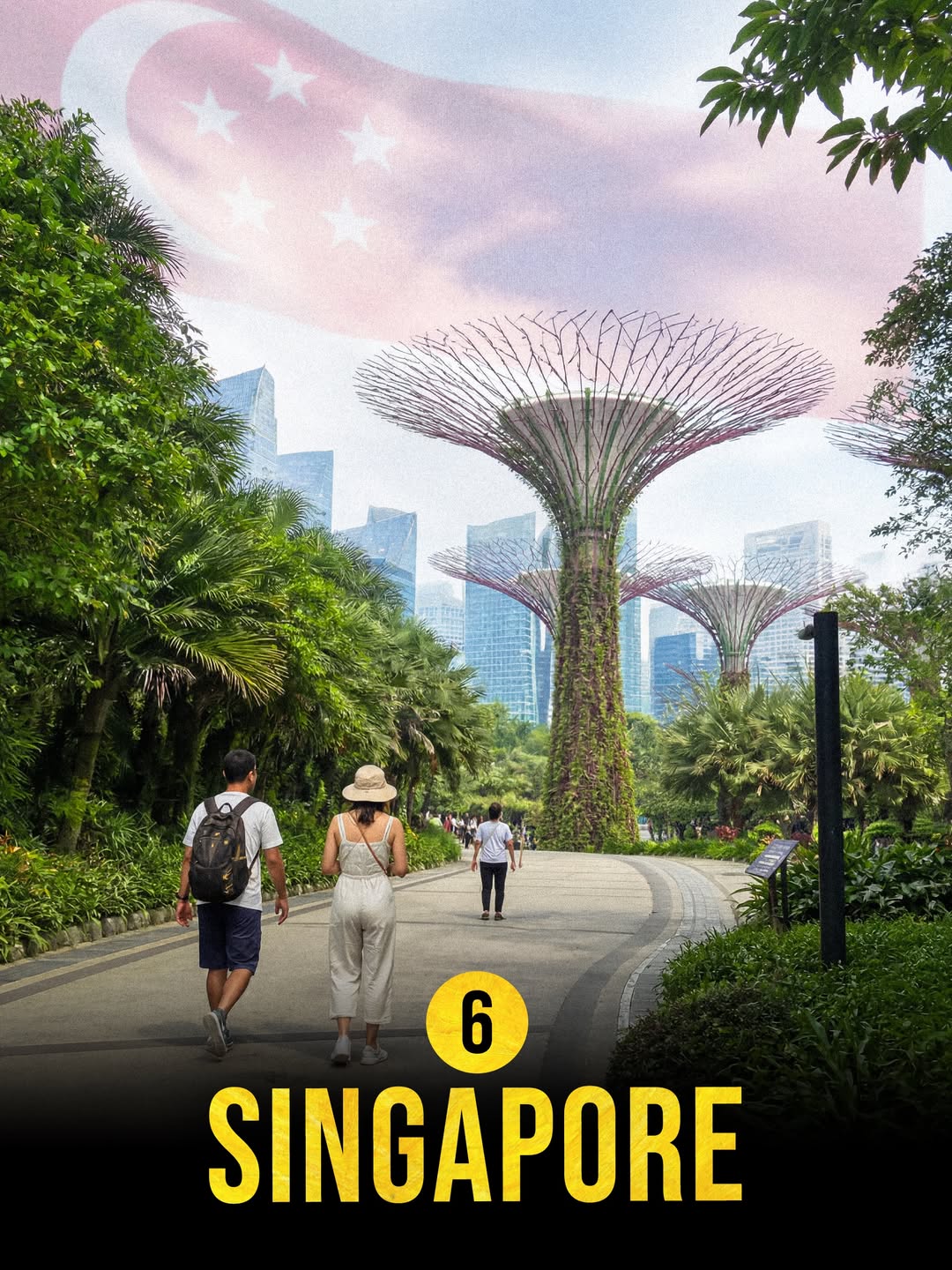
6. SINGAPORE
Singapore's inclusion as the sole Asian nation in the global top ten is a testament to what the city-state has achieved since its independence in 1965. In just over six decades, Singapore transformed from a developing port city with limited natural resources into one of the world's wealthiest, best-governed, and most stable nations.
The country's peace ranking reflects its exceptionally low crime rate, highly effective rule of law, political stability under the People's Action Party's long governance, and its strategic positioning as a neutral, trade-focused hub in a geopolitically complex region. Singapore's presence in the top ten also highlights the broader challenge for the rest of Asia — a region home to several of the world's most significant ongoing territorial disputes, military build-ups, and geopolitical flashpoints.
7. PORTUGAL
Portugal's seventh-place ranking reflects a quiet but sustained transformation. Once one of Western Europe's poorer and more politically volatile nations — having only transitioned from authoritarian rule to democracy in 1974 — Portugal has built a stable, EU-integrated democracy with strong institutions, low crime, and a consistently peaceful domestic environment.
The country's Atlantic coastline, mild climate, and growing international profile as a destination for digital nomads and foreign investment have raised its global visibility in recent years, while its peace credentials have remained consistently strong.
8. DENMARK
Denmark's eighth-place ranking is unsurprising for a nation consistently ranked among the world's happiest, least corrupt, and best-governed countries. The Danish model — combining high taxation, comprehensive social welfare, strong labour protections, and high levels of civic trust — produces outcomes in quality of life and social stability that regularly place it at or near the top of virtually every positive international ranking.
Denmark is a NATO member and maintains a professional military, but its domestic environment is characterised by extremely low crime, strong democratic institutions, and a political culture built on consensus and compromise.
9. SLOVENIA
Slovenia is perhaps the least internationally recognised nation in the top ten, but its ninth-place ranking reflects a genuinely impressive trajectory. The small Central European nation of approximately two million people declared independence from Yugoslavia in 1991 following a ten-day war and subsequently built one of the most successful democratic transitions in post-communist Europe.
Slovenia joined both NATO and the European Union in 2004 and has since established itself as one of the region's most stable, well-governed, and prosperous small states. Its inclusion in the global peace top ten is a recognition of what sustained institutional development and democratic consolidation can achieve in a relatively short historical period.
10. FINLAND
Finland completes the top ten — a fitting position for a country that has also been consistently ranked as one of the world's happiest nations. Finland's peace ranking reflects its strong democratic institutions, very low corruption levels, high educational attainment, and deeply embedded culture of social trust and civic participation.
Finland joined NATO in 2023 following Russia's full-scale invasion of Ukraine — a significant shift in its historically neutral foreign policy stance — but its domestic environment remains one of the most peaceful and stable on earth.
ANALYSIS: WHAT THE RANKINGS TELL US
The 2026 Global Peace Index top ten reveals several consistent patterns worth examining.
Small states punch above their weight.The majority of the top ten nations have populations under ten million. Smaller states tend to have more cohesive social environments, lower inequality, stronger institutional trust, and less complex internal political dynamics than larger, more diverse nations. Scale, in the context of peace, appears to be a disadvantage.
Democratic institutions and social trust are the foundation.** Every nation in the top ten is a functioning liberal democracy with strong, independent institutions, low corruption, and high levels of public trust in government. Peace, as the index measures it, is not simply the absence of war — it is the presence of the social and institutional conditions that prevent conflict from taking root.
Europe's model remains the global benchmark. Eight of ten top positions being held by European nations reflects the continent's long investment in integration, cooperation, and the resolution of interstate conflicts through diplomacy and shared institutions rather than military confrontation. The European Union project, whatever its political complexities, has demonstrably contributed to making its member states among the world's most peaceful.
Asia's peace challenge is structural. Singapore's singular presence in the top ten highlights how difficult it is for Asian nations — even those with strong governance records — to achieve top-tier peace rankings given the region's active territorial disputes, historical tensions, and military build-ups involving major powers.
WHAT HAPPENS NEXT
The Global Peace Index is published annually and its rankings shift — sometimes significantly — in response to global events, political changes, and emerging conflicts. Nations that currently sit just outside the top ten — including Canada, Japan, and several other Northern European countries — remain close contenders, while ongoing geopolitical instability in multiple regions continues to affect the rankings of nations further down the list.
For policymakers and international organisations, the consistent dominance of the same cluster of nations at the top of the peace index raises important questions about whether the conditions that produce peaceful societies can be exported, replicated, or supported in countries currently further down the ranking.
CONCLUSION
The 2026 Global Peace Index top ten confirms what has been true for over a decade: small, well-governed, democratic, socially cohesive nations — predominantly in Europe — set the global standard for peace and safety. Iceland's continued leadership of the ranking, Singapore's distinction as Asia's sole representative in the elite group, and the consistent presence of nations like New Zealand, Switzerland, and Finland in the upper reaches of the index all point to the same underlying truth: peace is not an accident. It is the product of sustained investment in institutions, social trust, democratic governance, and the deliberate choice to resolve disputes through cooperation rather than conflict.
CM NEWS World Affairs Desk covers global rankings, geopolitical developments, and international affairs across all regions.