Business
Saudi Arabia's NEOM Megaproject Collapses: The Rise and Fall of Crown Prince MBS's Desert Utopia
The ambitious $500 billion NEOM development, including its flagship 'The Line' smart city, has suffered a dramatic scaling back as Saudi Arabia's futuristic desert vision meets harsh economic and logistical reality
By CM NEWS World Affairs & Business Desk
Published: June 3, 2026
Saudi Arabia's Crown Prince Mohammed bin Salman's grandest vision — a carbon-neutral, technologically advanced megacity rising from the desert sands of northwest Saudi Arabia — has effectively collapsed under the weight of its own ambition. The NEOM project, once promoted as the future of human civilisation and a centrepiece of the Kingdom's Vision 2030 economic transformation plan, has undergone a dramatic and humbling contraction, with its most iconic component, a 170-kilometre linear smart city known as The Line, now confirmed to be a fraction of what was originally promised to the world.
KEY FACTS
- NEOM is a $500 billion megadevelopment project launched by Saudi Crown Prince Mohammed bin Salman (MBS)
- The project's flagship component, The Line, was designed as a 170km long, 500m high linear smart city intended to house 9 million residents
- The Line has been dramatically scaled back — reports indicate only a tiny fraction of the originally planned structure will be completed in the near term
- NEOM was positioned as the centrepiece of Saudi Arabia's Vision 2030 plan to diversify the economy away from oil dependence
- The project faced criticism from human rights organisations over the forced displacement of the Huwaitat tribe from the land
- Financial pressures, falling oil revenues, and engineering challenges have all contributed to the project's contraction
When Crown Prince Mohammed bin Salman unveiled NEOM to the world, the ambition was unlike anything previously announced by any government on earth. A vast, purpose-built region in the Tabuk Province of northwestern Saudi Arabia — spanning desert, mountains, and coastline along the Red Sea — would be transformed into a global hub for innovation, tourism, technology, and sustainable living.
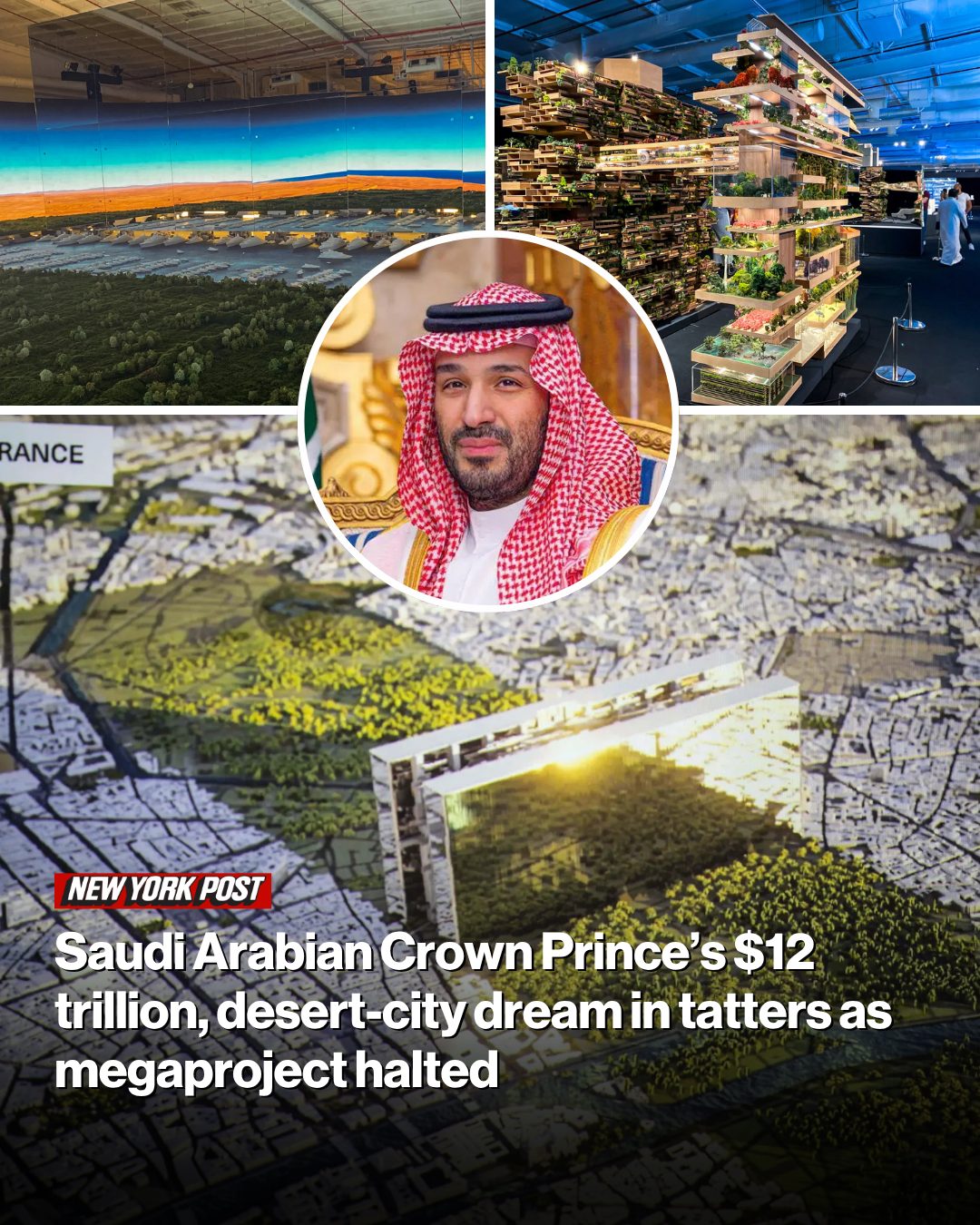
At its heart would be The Line: a concept so radical it defied conventional urban planning entirely. Rather than spreading outward like a traditional city, The Line would stretch 170 kilometres in a straight line across the desert, rising 500 metres into the air, and housing a planned population of nine million people within mirrored exterior walls that would reflect the surrounding landscape. There would be no cars, no roads at street level, and no carbon emissions. Residents would travel by high-speed underground transit. Artificial intelligence would manage resources, logistics, and city services in real time.
The project was presented not merely as a building programme but as a reimagining of what human civilisation could look like.
That vision has now met reality — and the collision has been severe.
WHAT WENT WRONG
Reports emerging over recent months have confirmed that The Line, as originally conceived, will not be built. The scale of construction required — in one of the world's most inhospitable desert environments, using technologies that in many cases do not yet exist at commercial scale — proved beyond what even Saudi Arabia's vast sovereign wealth resources could sustain, particularly against a backdrop of fluctuating global oil prices and competing domestic financial priorities.
The engineering challenges alone were staggering. Building a continuous 170-kilometre structure at 500 metres of height, with internal climate control, high-speed transit, and self-sustaining energy systems, presented problems that the world's leading construction and engineering firms struggled to solve within projected budgets or timelines.
Sources familiar with the project's internal planning indicated that the initial phase of The Line — the section that may actually be completed — would cover only a small fraction of the originally announced length, housing a population far below the nine million figure that featured so prominently in the original promotional materials.
Other components of the broader NEOM development, including the luxury mountain resort Trojena — which is scheduled to host the 2029 Asian Winter Games — and the floating industrial complex Oxagon, have also faced delays and scope reductions.
THE VISION 2030 CONTEXT
To understand NEOM's significance — and the weight of its contraction — it is necessary to understand the strategic context in which it was conceived.
Saudi Arabia's economy remains heavily dependent on oil revenues, a vulnerability that Crown Prince Mohammed bin Salman identified as an existential long-term risk when he launched Vision 2030 in 2016. The plan's broad ambition was to diversify the Saudi economy across tourism, entertainment, technology, and manufacturing — reducing the Kingdom's reliance on hydrocarbon exports before global energy transition dynamics potentially diminish their value.
NEOM was positioned as the most visible and dramatic symbol of that transformation — a proof of concept for the new Saudi Arabia that MBS intended to build. Its international marketing was sophisticated and expensive, targeting global investors, technology companies, and potential future residents with a message that Saudi Arabia was not just an oil state but an emerging centre of global innovation.
The project attracted significant international interest in its early years, with major consultancy firms, architects, and technology companies all engaging with its planning processes. However, turning visionary concepts into physical infrastructure at the scale proposed proved an entirely different proposition.
HUMAN RIGHTS DIMENSION
The NEOM project has also attracted sustained international criticism on human rights grounds. The Huwaitat tribe, an indigenous community whose ancestral lands fell within the NEOM development zone, was forcibly displaced to make way for the construction. Members of the community who resisted relocation faced severe consequences, with at least one individual reported killed and others imprisoned for opposing the displacement.
Human rights organisations including Amnesty International documented these events and raised them with international bodies, adding a significant ethical dimension to the project's already complicated profile. The combination of broken promises on scale, financial difficulties, and the human cost of displacement has made NEOM one of the more scrutinised infrastructure projects in recent global history.
WHAT NEOM'S COLLAPSE MEANS
The effective failure of NEOM's most ambitious elements carries implications beyond Saudi Arabia's borders. It represents a cautionary lesson about the gap between visionary urban planning and physical, financial, and engineering reality — and about the risks of anchoring national economic transformation strategies to single flagship projects of unprecedented scale.
For Crown Prince Mohammed bin Salman personally, the scaling back of The Line is a reputational setback. The project was presented as his vision — his personal guarantee of Saudi Arabia's future. Its contraction will be interpreted by observers as a significant miscalculation, even if the broader Vision 2030 agenda continues to produce results in other sectors such as tourism, entertainment, and sports investment.
For the global construction and smart city industries, NEOM's difficulties also raise questions about the viability of truly radical urban concepts when taken from the drawing board to the desert floor.
WHAT HAPPENS NEXT
Saudi Arabia is unlikely to abandon NEOM entirely. The reputational and financial investment already committed is too large for a complete withdrawal, and elements of the broader development — particularly those tied to the 2029 Asian Winter Games — carry contractual and international obligations that cannot easily be walked back.
What appears certain is that the project will be substantially rationalised — built in phases, at reduced scale, with more conventional near-term components taking precedence over the more radical long-term concepts. How the Saudi government manages the narrative around that transition will be closely watched by international investors, partner governments, and the domestic audience to whom Vision 2030 was originally sold.
CONCLUSION
The collapse of NEOM's most ambitious promises stands as one of the most dramatic examples in recent history of visionary infrastructure ambition outpacing practical reality. From a 170-kilometre linear city of nine million people to a scaled-back initial phase of uncertain dimensions, The Line's trajectory tells a story about the limits of what even the wealthiest sovereign projects can achieve when confronted with the unforgiving demands of engineering, finance, and geography. Saudi Arabia's broader economic transformation continues — but its most famous symbol has been significantly diminished.
CM NEWS World Affairs Desk will continue to monitor developments related to the NEOM project and Saudi Arabia's Vision 2030 economic reform programme.