Sports
Real Madrid Named World's Most Valuable Football Club at $9.5 Billion — Despite Two Trophyless Seasons
Real Madrid have been officially named the most valuable football club in the world by Forbes, with a staggering valuation of $9.5 billion — a landmark figure that cements the Spanish giants' financial dominance in global football, even as the club navigates one of its most difficult trophy droughts in recent memory.
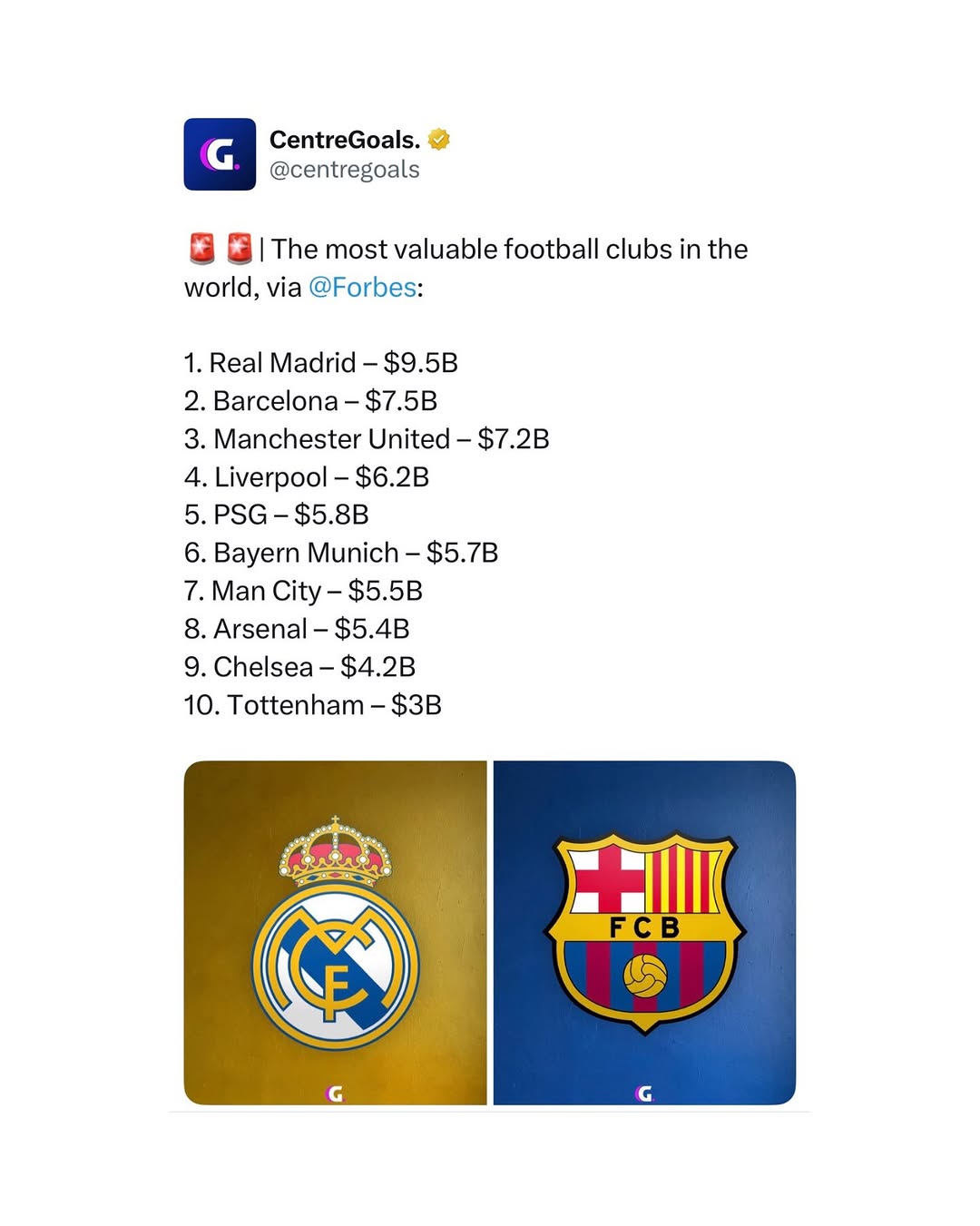
Real Madrid Top Forbes' 2025 Most Valuable Football Clubs List With $9.5 Billion Valuation
The Forbes Rankings: Who Made the Top 10?
Forbes' latest valuation list reveals a clear hierarchy at the top of world football's financial landscape. Real Madrid lead the pack by a significant margin, followed by Spanish rivals Barcelona at $7.5 billion. English clubs dominate the remainder of the top ten:
1. Real Madrid — $9.5B
2. Barcelona — $7.5B
3. Manchester United — $7.2B
4. Liverpool — $6.2B
5. PSG — $5.8B
6. Bayern Munich — $5.7B
7. Manchester City — $5.5B
8. Arsenal — $5.4B
9. Chelsea — $4.2B
10. Tottenham Hotspur — $3.0B
The list underscores the enduring financial power of European football's elite clubs, with six of the top ten based in England and two in Spain.
Madrid's Financial Supremacy: How Did They Get Here?
Real Madrid's $9.5 billion valuation does not arrive by chance. It is the product of decades of strategic brand building, unmatched European success, and a global fanbase estimated at over 500 million supporters worldwide.
Central to Madrid's commercial power is the Santiago Bernabéu Stadium, which completed a landmark €1.5 billion renovation in recent years. The redeveloped arena now functions as a multi-purpose entertainment venue capable of hosting concerts, boxing events, NFL games, and other high-revenue events beyond football — transforming the stadium from a match-day asset into a year-round revenue-generating machine.
The club's commercial partnerships are among the most lucrative in sport. Their shirt sponsorship deal with Emirates and their long-standing technical partnership with Adidas contribute hundreds of millions annually. Real Madrid's media rights revenues, boosted by their consistent presence in the UEFA Champions League, have also played a critical role in sustaining their financial position at the top.
Furthermore, the signings of global superstars over recent seasons — most notably Kylian Mbappé — have only strengthened the club's commercial profile and merchandising revenues, even when on-pitch results have been inconsistent.
The Trophy Drought: Context Behind the Headlines
Despite their financial supremacy, Real Madrid have endured two consecutive seasons without winning a major trophy — a relatively rare occurrence for a club of their stature and expectations.
It is important to place this in context. Real Madrid are historically the most decorated club in European football history, having won 15 UEFA Champions League titles. Their standards are extraordinarily high, and a two-year trophy absence — while notable — does not reflect a club in structural decline. Rather, it reflects the natural transitional cycles that even the world's greatest clubs experience.
The 2024–25 season proved particularly challenging, as the squad underwent significant reshaping following the departures of several key figures. The integration of high-profile arrivals, including Mbappé, into the team's system required time and adjustment — factors that inevitably affected short-term competitiveness.
Managerial and squad dynamics have also been scrutinised. However, club president Florentino Pérez has signalled continued investment in both infrastructure and playing talent, reinforcing the belief that Madrid's long-term trajectory remains firmly upward.
What This Valuation Means for Football
Real Madrid's $9.5 billion valuation carries significance far beyond one club. It reflects the broader transformation of elite football into a global entertainment and media business.
Modern football clubs are no longer valued solely on their trophies or playing squads — they are assessed on media rights portfolios, stadium revenues, digital audiences, brand licensing, and their capacity to attract commercial partners. By these metrics, Real Madrid operate in a category of their own.
The gap between Madrid's valuation and that of their nearest rivals also highlights an increasingly unequal financial landscape in world football — one that regulatory bodies such as UEFA continue to monitor through Financial Fair Play and newer sustainability frameworks.
For smaller clubs and emerging leagues, the figures serve as a benchmark of just how far the commercialisation of the sport has progressed at the elite level.
Conclusion
Real Madrid's recognition as the world's most valuable football club at $9.5 billion is a testament to the club's extraordinary commercial infrastructure, global brand, and long-term institutional strength. While their recent absence from the trophy cabinet has drawn attention, financial dominance and on-pitch success do not always move in lockstep.
With continued investment in their squad and a state-of-the-art stadium generating revenues across multiple industries, Real Madrid appear well-positioned to maintain their position atop football's financial hierarchy for years to come. Whether their bank balance will soon be matched once again by silverware remains the central question for supporters and analysts alike.
This article was produced by the CM NEWS Sports Desk. All valuations cited are sourced from Forbes' official football club rankings.