Sports
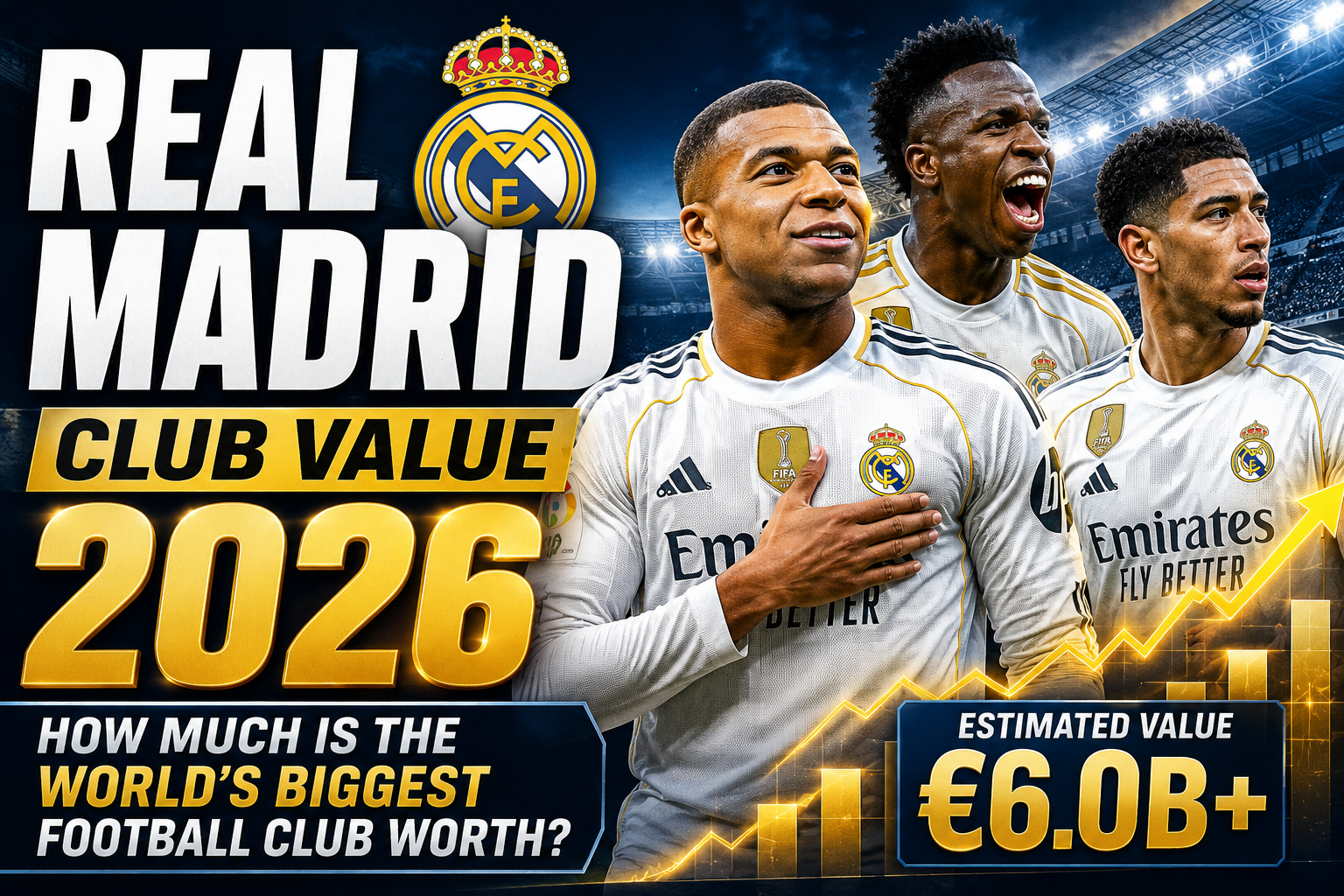
Real Madrid Club Value 2026: How Much Is the World's Biggest Football Club Worth?
From the Bernabéu to the boardroom, Real Madrid's financial empire continues to grow — here is a complete breakdown of the Spanish giants' club value, revenue streams, and what makes them the most valuable football institution on the planet.
Byline: CM News Desk
Publication Date: June 3, 2026
Real Madrid is not just a football club. It is a global brand, a financial powerhouse, and by almost every measure, the most valuable sports organisation in European football. In 2026, as the club continues to dominate both on the pitch and in the transfer market, the question of exactly how much Real Madrid is worth has never generated more interest — from fans, investors, and football analysts alike. The answer runs into the billions, and the numbers tell a story of extraordinary commercial growth that extends far beyond matchday revenues.
Key Facts
- Estimated club value (2026): Approximately $6.6 billion — $7 billion (Forbes / Transfermarkt estimates)
- Annual revenue: Over €1 billion per season
- Stadium: Santiago Bernabéu, Madrid, Spain (recently renovated at a cost of over €1 billion)
- Recent UEFA Champions League titles: Multiple in the last decade, cementing global commercial appeal
- Primary revenue streams: Broadcasting rights, commercial partnerships, matchday income, merchandise
- Owner: Florentino Pérez (club president, member-owned structure)
- Global fanbase: Estimated 500+ million followers worldwide
Real Madrid's financial valuation in 2026 places the club among the most valuable sports franchises anywhere in the world — not just in football, but across all professional sports globally. According to the latest estimates from Forbes and leading football finance analysts, the club's total value sits in the range of $6.6 billion to $7 billion, a figure that has grown significantly over the past decade driven by Champions League success, a massive stadium renovation, and an aggressive global commercial strategy.
To understand what makes Real Madrid worth this staggering sum, it is necessary to look beyond the trophy cabinet — though that cabinet is extraordinary in its own right — and examine the multiple revenue streams that underpin the club's financial model.
Broadcasting Revenue
Real Madrid benefits enormously from Spain's La Liga broadcasting deal and, crucially, from UEFA's Champions League distribution model. As one of the competition's most historically successful and commercially attractive clubs, Madrid receives among the highest payouts in European football each season from UEFA's revenue sharing pool. With La Liga securing increasingly lucrative international broadcast deals — particularly in North America, Asia, and the Middle East — the club's broadcasting income continues to climb year on year.
Commercial Partnerships
Real Madrid's global brand attracts partnerships with some of the world's largest corporations. Their long-standing kit deal with Adidas is among the most valuable in world football. The club also maintains high-value sponsorship agreements with Emirates airline (shirt sponsor), Audi, Hewlett Packard Enterprise, and a growing roster of regional and global partners. Commercial revenue at Real Madrid now accounts for a substantial portion of total income — a deliberate strategy by club leadership to reduce dependence on any single income source.
The Bernabéu Renovation Effect
Perhaps the single biggest driver of Real Madrid's rising valuation in recent years has been the extraordinary renovation of the Santiago Bernabéu stadium. Completed at a cost of over €1 billion, the newly transformed Bernabéu is no longer simply a football stadium — it is a year-round entertainment venue. The stadium now features a retractable roof, a fully rollable pitch, and a state-of-the-art concert and events infrastructure that allows it to host major international concerts, boxing events, NFL games, and other premium entertainment experiences throughout the calendar year.
This transformation has fundamentally changed Real Madrid's revenue model. Rather than generating matchday income for roughly 20 home matches per season, the Bernabéu now functions as a commercial asset 365 days a year. Analysts estimate that the renovated stadium adds hundreds of millions of euros in additional annual revenue compared to the old structure — and that income is only growing as the club's events calendar expands.
Player Values and Squad Investment
Real Madrid's squad value also contributes to the club's overall financial standing. With a roster that includes some of the highest-valued players in world football — including Kylian Mbappé, Vinícius Jr., and Jude Bellingham — the club's playing assets represent a significant portion of its balance sheet. High squad values attract sponsorship premiums and broadcast interest, creating a virtuous cycle where on-pitch success and commercial growth reinforce each other.
Background: Real Madrid's Rise to Financial Dominance
Real Madrid's financial supremacy did not happen overnight. The club's commercial transformation began in earnest in the early 2000s under the presidency of Florentino Pérez, who pioneered the "Galácticos" policy of signing the world's most marketable players — Zinedine Zidane, Ronaldo, David Beckham, and others — not purely for sporting reasons but as global marketing assets.
That strategy fundamentally repositioned Real Madrid as a worldwide entertainment brand rather than simply a Spanish football club. Jersey sales, global tour revenues, and international broadcast interest surged. The model has been refined and expanded ever since.
By the 2020s, Real Madrid had developed one of the most sophisticated commercial operations in world sport — a club that sells out the Bernabéu, fills stadiums on pre-season tours in the United States and Asia, and generates meaningful income from digital content, gaming partnerships, and NFT and metaverse ventures.
For additional context on football's financial landscape, read CM News' analysis of [the most valuable football clubs in the world in 2026] and [how the 2026 FIFA World Cup is reshaping football's global commercial market].
Is Real Madrid's Valuation Justified?
Some financial analysts argue that football club valuations — including Real Madrid's — are inflated relative to traditional business metrics. Unlike publicly traded companies, football clubs are valued heavily on brand equity, future revenue potential, and the competitive market for elite sporting assets, rather than on straightforward profitability ratios.
However, Real Madrid's case is stronger than most. The club generates over €1 billion in annual revenue, owns one of the world's premier entertainment venues outright, holds debt at manageable levels relative to income, and possesses a global fanbase of over 500 million people that grows larger each year as football expands into new markets — particularly the United States, India, and Southeast Asia.
The 2026 FIFA World Cup, being hosted across the United States, Canada, and Mexico this summer, is expected to accelerate football's commercial growth in North America significantly — a market where Real Madrid, through Mbappé's profile and previous pre-season tours, has invested heavily in brand building.
In that context, the club's multi-billion dollar valuation reflects not just what Real Madrid is worth today, but what it is positioned to be worth in the years ahead.
What Happens Next
Real Madrid's financial trajectory points firmly upward. The Bernabéu's events calendar is expanding. La Liga's international broadcasting deals are being renegotiated at higher values. The club's digital and streaming revenue is growing. And with a squad built around players in their early-to-mid twenties — Mbappé, Vinícius, Bellingham — the on-pitch product is expected to remain at the elite level necessary to sustain Champions League participation and the commercial premiums that come with it.
Transfer activity in the summer of 2026 will also be watched closely by financial analysts. Any major signing would add to squad valuations and likely trigger another round of commercial partnership upgrades.
Real Madrid's next published financial accounts, expected later in 2026, will provide a clearer picture of post-renovation Bernabéu revenues and offer analysts updated data on which to base revised valuations.
Conclusion
Real Madrid's estimated value of between $6.6 billion and $7 billion in 2026 reflects a club that has mastered the intersection of sporting excellence and commercial ambition. From the transformed Santiago Bernabéu to a squad of generational talents, from a global sponsorship empire to one of the most recognisable brands in world sport, Real Madrid has built a financial machine that extends far beyond ninety minutes of football.
Whether measured by trophies, revenues, or brand reach, the answer to the question of how much Real Madrid is worth in 2026 is the same: more than almost anyone else — and growing.
CM News will continue to cover Real Madrid and the global football finance landscape throughout 2026.
More stories
[Forbes Football Club Valuations] and [Transfermarkt — Real Madrid Club Profile]