World
Hundreds Protest Against US Ebola Quarantine Facility in Kenya as High Court Battle Continues
Demonstrators march on Laikipia Air Base in Nanyuki as Kenya's government defies a court order and pushes ahead with plans to house American Ebola patients on Kenyan soil
By CM NEWS Africa Desk | June 1, 2026
A mounting public and legal crisis is unfolding in Kenya over a controversial plan by the United States government to establish an Ebola quarantine facility at a military base in the country's central highlands. Hundreds of demonstrators took to the streets of Nanyuki on Monday, marching on the gates of Laikipia Air Base in protest against the arrangement — even as Kenya's government signalled it would press ahead with the facility despite a court order temporarily halting its establishment. The dispute has exposed deep divisions between ordinary Kenyans, the medical community, civil society, and the government of President William Ruto over the country's role in managing a foreign nation's disease response.
Key Facts
- Hundreds of protesters gathered outside Laikipia Air Base in Nanyuki, Laikipia County, on Monday, June 1, 2026
- Kenya's High Court suspended the facility's establishment on May 30, pending a full hearing scheduled for June 2
- The planned facility is a 50-bed quarantine unit for American citizens exposed to Ebola in the Democratic Republic of Congo (DRC)
- The US committed $13.5 million toward Kenya's Ebola preparedness as part of the arrangement
- Kenya has recorded zero Ebola cases; the DRC outbreak has infected over 900 people and killed at least 220
- The Kenyan government is reportedly proceeding with the facility despite the court order
.
The Protests: Anger on the Streets of Nanyuki
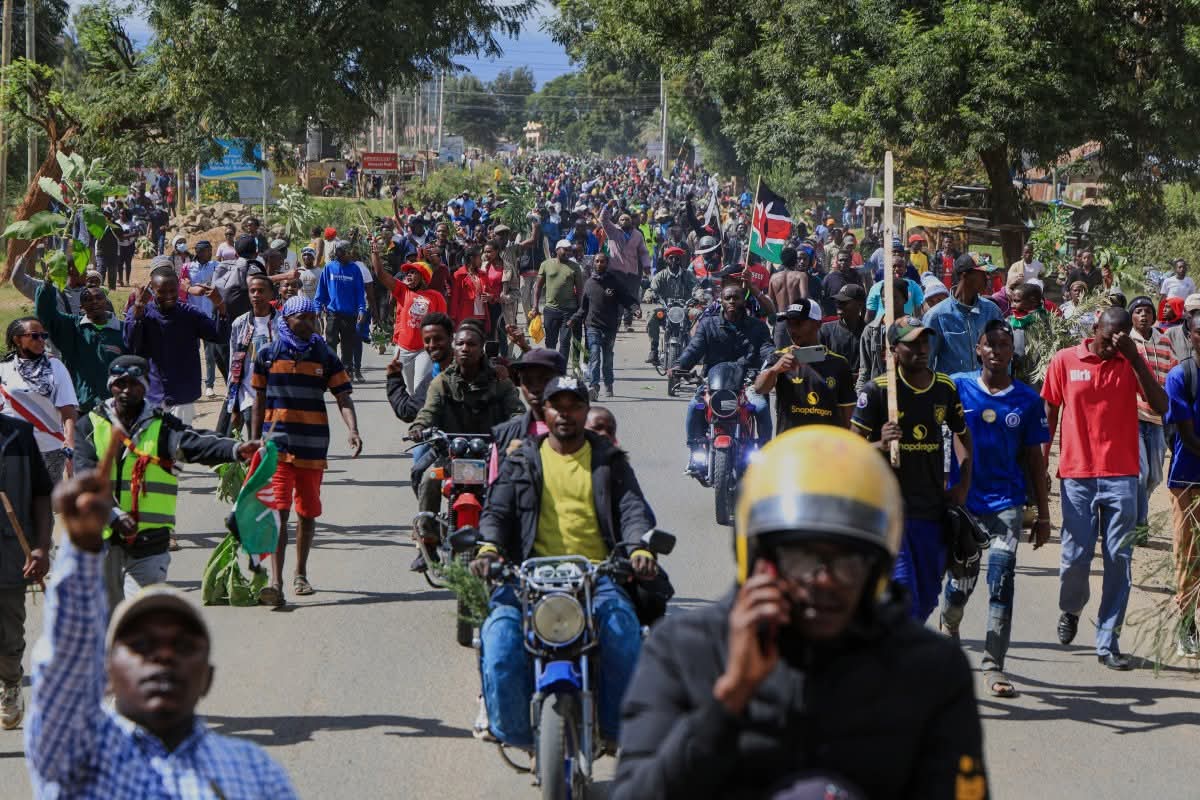
Hundreds of youths in Kenya's central town of Nanyuki on Monday demonstrated against the establishment at the Laikipia Air Base of an Ebola quarantine centre for American citizens exposed to the virus. The protests came two days after Kenya's High Court suspended the establishment of the facility and the arrival of any foreign patients, pending the hearing of a case filed by the Law Society of Kenya and a constitutional watchdog.
Reuters footage obtained on Monday showed a crowd of about 100 people standing approximately four kilometres from the site of the planned facility, blowing whistles, with some riding atop a pickup truck. Smoke could be seen rising from something burning on the road. Local residents put the number of protesters in the hundreds. NTV Kenya and Citizen Kenya television channels showed footage of people standing by a wall outside the air base, with a tank stationed there and a handful of soldiers on guard.
The mood was tense but largely peaceful, with anti-riot police officers deployed to the scene. The demonstration reflected the deep unease felt by local residents who live and work in close proximity to the base.
Local Leaders Speak Out
Local leaders, including Laikipia Governor Joshua Irungu, have publicly opposed the quarantine centre, telling journalists: "This will expose our people to Ebola," and noting that many local residents work inside the air base and could be exposed. [WSLS 10 News]
The governor's concerns echo those of thousands of residents who argue that Kenya, a country which has recorded no Ebola cases, should not be required to assume health risks generated by an outbreak occurring more than 1,500 kilometres away in the DRC.
The Court Order and the Legal Challenge
Judge Patricia Nyaundi issued a provisional conservatory order barring the Kenyan government from "establishing, operationalising, facilitating, approving or permitting" any Ebola quarantine, isolation, or treatment facility under any arrangement with the United States or a foreign government, and from admitting anyone exposed to or infected with the virus, pending a hearing set for June 2.
The legal challenge was brought by two organisations. The non-profit Katiba Institute, whose mission is to defend Kenya's constitution, filed the restraining application citing a lack of transparency and public participation and arguing that "constitutional recklessness" had implications for "grave public health."
The Law Society of Kenya, alongside the Katiba Institute, cited Kenya's fragile health system as the primary reason why foreign Ebola patients should not be quarantined in the country. The Law Society further warned that Kenya lacked the high-containment infrastructure required to safely manage such a facility, potentially exposing the public to serious health risks.
The Government's Position — and Its Defiance of the Court
Despite the court's clear directive, Kenya's government has signalled it will not stand down. Kenya's government is pushing ahead with plans to establish the Ebola quarantine and treatment facility at the military installation in partnership with the United States, even after the Kenyan High Court temporarily barred the arrangement.
Health Minister Aden Duale attempted to reframe the narrative. On Sunday, the Health Minister said the quarantine centre was for "everyone" and not exclusively for US nationals. However, this explanation has done little to quell public anger, with critics pointing out that the facility was explicitly designed and communicated as a response mechanism for American citizens.
The US Department of State committed $13.5 million toward Kenya's Ebola preparedness following a phone discussion between US Secretary of State Marco Rubio and President Ruto — a financial arrangement that critics argue amounts to Kenya being paid to take on a health burden that America itself was unwilling to bear.
The Kenyan Doctors' Union Warns of Strike Action
The medical community has been among the most vocal opponents of the plan. The Kenyan doctors' union issued a 48-hour strike alert in preparation should the government proceed with the deal, accusing authorities of putting public health at risk. The union said the US appeared unwilling to allow Ebola-exposed individuals onto its own soil and warned that Kenya should not become a "dumping ground."
The union's language was stark. In an official statement, doctors described themselves as "utterly disgusted by the government's apparent willingness to trade national biosecurity" — language that underscores just how deep the opposition runs within Kenya's own health sector, the very professionals who would be expected to manage any outbreak scenario.
The Ebola Outbreak: What Is Happening in the DRC
To understand why the United States sought an offshore quarantine solution, it is necessary to understand the scale of the current Ebola crisis in Central Africa. The current Ebola outbreak is focused in the DRC's conflict-plagued Ituri Province, on the border with Uganda and South Sudan, and is believed to have killed at least 220 people and infected more than 900 others.
At least 263 confirmed cases of the Bundibugyo strain — a rare form of Ebola for which there is no approved vaccine or treatment — have been reported in the DRC. Kenya has not recorded any Ebola cases, but neighbouring Uganda has reported nine cases and closed its border with the DRC. [WSLS 10 News]
WHO Director-General Tedros Adhanom Ghebreyesus confirmed the outbreak is heavily concentrated in Ituri province, which accounts for more than 90 percent of reported cases, with smaller numbers also detected in North Kivu and South Kivu provinces.
The Bundibugyo strain carries a mortality rate of between 30 and 50 percent, compared to up to 90 percent for the more lethal Zaire strain. Critically, no approved vaccine or treatment currently exists for the Bundibugyo variant — a fact that has amplified fears about the consequences of housing exposed individuals in a country with limited medical infrastructure.
Why Kenya? The US Strategy Explained
A senior Trump administration official said the US had received approval from the Kenyan government for a 50-bed quarantine unit. The American strategy aimed to isolate asymptomatic individuals closer to the outbreak zone rather than repatriating potentially infected personnel directly to US soil.
The facility at Laikipia Air Base was built by the US military and was to be staffed by US Public Health Service personnel. Patients who developed symptoms or tested positive would be moved to other facilities.
Earlier this month, an American doctor working in the DRC who tested positive for Ebola was evacuated to Germany for treatment. At the same time, another US national with high-risk exposure was transferred to the Czech Republic for care — highlighting the precedent of placing exposed individuals in third countries rather than repatriating them to America.
What Happens Next
The Kenya High Court is scheduled to hear the full case on June 2, at which point a further ruling is expected on whether the suspension will be extended or lifted. The outcome will have significant implications — not only for the Laikipia facility, but for Kenya's broader relationship with the United States and for the question of whether African nations can be used as offshore health management hubs for Western governments.
The Africa CDC Director-General Jean Kaseya noted that a vaccine and treatment for the Bundibugyo strain were expected by the end of 2026, but warned that international funding pledges had collapsed from nearly $500 million to approximately $290 million in recent days — a development that could further strain efforts to contain the outbreak at its source.
Conclusion
The standoff over the proposed Ebola quarantine facility at Laikipia Air Base has become one of Kenya's most charged political controversies in recent memory, touching on sovereignty, public health, constitutional law, and the nature of Kenya's relationship with its international partners. With the High Court set to rule imminently, the protests continuing, and the government defying its own judiciary, the situation remains deeply unresolved. At its heart, the dispute raises a fundamental question: should a nation with zero Ebola cases be required to bear the health burden of a foreign government's citizens — and at what cost?
CM NEWS will continue to follow all developments in the Kenya Ebola quarantine story as they unfold.