World
Germany Commits Ksh150 Million to Boost East Africa's Ebola Response as Regional Health Crisis Deepens
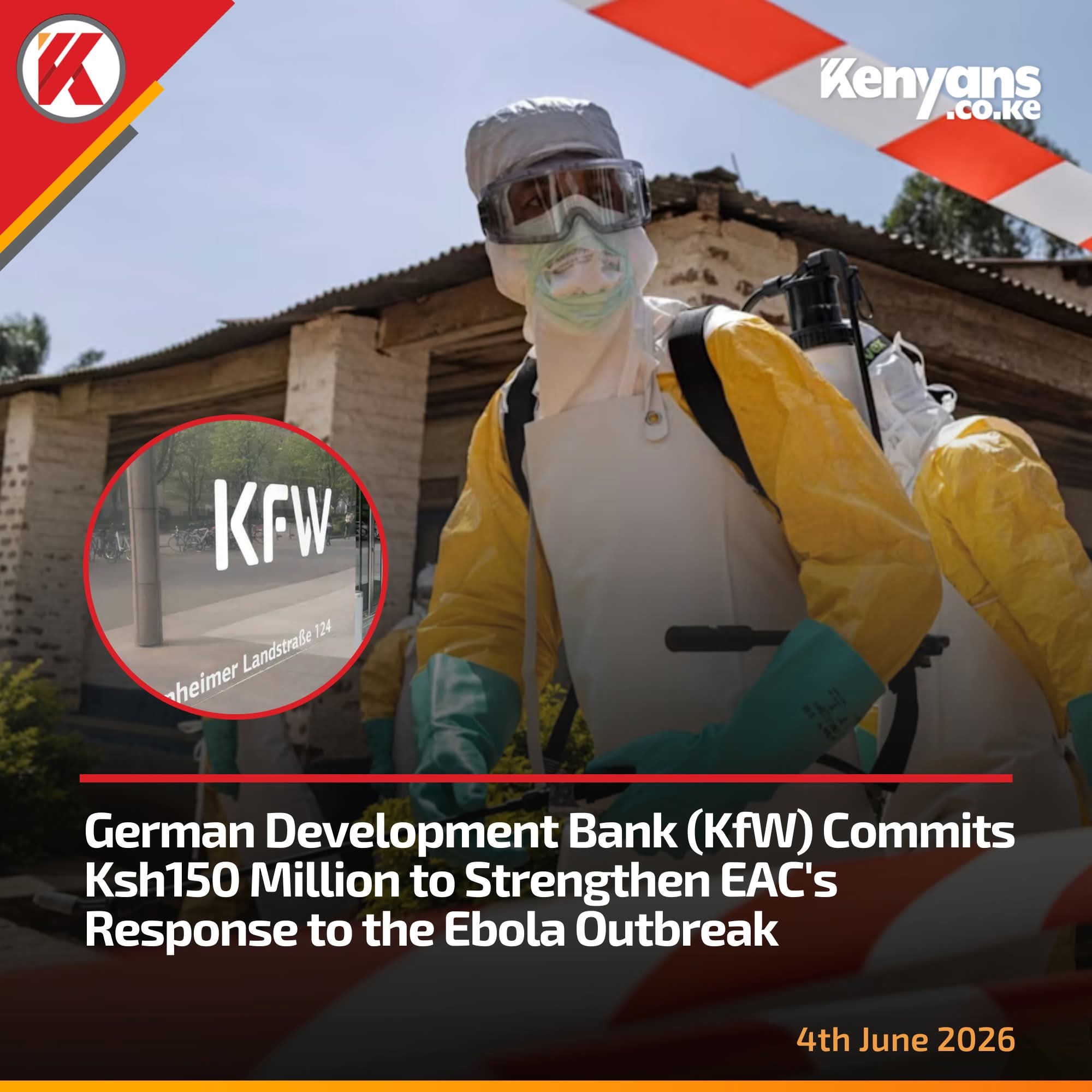
The German Development Bank KfW has pledged approximately Ksh150 million to strengthen the East African Community's capacity to detect, contain, and respond to the ongoing Ebola outbreak threatening the region
By CM NEWS East Africa & Health Desk Published: June 4, 2026
Germany's state-owned development finance institution, KfW — Kreditanstalt für Wiederaufbau — has committed Ksh150 million to bolster the East African Community's emergency response to the Ebola virus outbreak currently affecting the region. The funding announcement, made on June 4, 2026, represents a significant injection of international financial support at a critical moment for East African health authorities working to contain one of the world's most dangerous and feared infectious diseases before it spreads beyond its current boundaries.
The commitment underscores the growing international concern about the outbreak's trajectory and the recognition that effective regional containment requires resources that go beyond what affected nations can mobilise alone.
KEY FACTS
- KfW, the German Development Bank, has committed Ksh150 million to support the East African Community's Ebola response
- The funding is directed at strengthening regional detection, containment, and response capacity
- The East African Community (EAC) is the regional intergovernmental organisation whose member states include Kenya, Uganda, Tanzania, Rwanda, Burundi, South Sudan, Democratic Republic of Congo, and Somalia
- Ebola virus disease carries a fatality rate that can reach up to 90 percent in some outbreaks without adequate medical intervention
- The Democratic Republic of Congo has historically been the most affected EAC member state in previous Ebola outbreaks
- KfW is one of the world's largest development banks, operating on behalf of the German Federal Government
- The announcement was made on June 4, 2026
The German Development Bank KfW has stepped forward with a Ksh150 million commitment to the East African Community specifically to strengthen the bloc's coordinated response to the Ebola outbreak. The funding is understood to be directed at multiple pillars of outbreak response — including surveillance and early detection infrastructure, healthcare worker protective equipment, treatment facility capacity, community awareness programmes, and cross-border coordination mechanisms between EAC member states.
The significance of the timing cannot be overstated. Ebola outbreaks in East and Central Africa have historically been characterised by rapid escalation when early response capacity is inadequate — and by successful containment when resources, training, and coordinated regional action are mobilised quickly and effectively.
KfW's commitment adds to an increasingly urgent international effort to support East African governments and health authorities as they work to prevent the current outbreak from becoming a wider regional emergency. Germany's involvement reflects both the humanitarian dimension of its development policy and the recognition among European governments that infectious disease outbreaks in Africa carry potential implications for global health security if not effectively managed at source.
BACKGROUND: EBOLA IN EAST AFRICA
Ebola virus disease is caused by the Ebola virus, a member of the Filoviridae family of viruses, and is characterised by severe haemorrhagic fever in humans and other primates. The disease is transmitted through direct contact with the bodily fluids of infected individuals, making healthcare workers, family caregivers, and those involved in burial practices particularly vulnerable during outbreaks.
The virus was first identified in 1976 near the Ebola River in what is now the Democratic Republic of Congo — then Zaire — and the DRC has remained the country most frequently affected by outbreaks since that initial identification. The country experienced its deadliest outbreak between 2018 and 2020 in the North Kivu and Ituri provinces, which resulted in over 2,200 deaths and was the second-largest Ebola outbreak in recorded history.
Uganda has also experienced multiple Ebola outbreaks over the decades, and the porous nature of borders between DRC, Uganda, Rwanda, and other EAC member states means that any outbreak in one country carries immediate cross-border implications for its neighbours.
The East African Community, established formally in 2000 and significantly expanded in membership in subsequent years, has developed regional health coordination mechanisms — including the EAC Regional Integrated Surveillance and Laboratory Network (RISLNET) — specifically to address the kind of cross-border infectious disease threats that Ebola represents. However, the capacity and resources of these mechanisms are consistently stretched during active outbreaks, making international financial support critical.
ABOUT KfW — GERMANY'S DEVELOPMENT FINANCE ARM
KfW, which stands for Kreditanstalt für Wiederaufbau — meaning Reconstruction Credit Institute — was established in 1948 as part of the Marshall Plan to support the reconstruction of Germany after World War Two. It has since evolved into one of the world's largest and most active development finance institutions, with a mandate that spans domestic German lending as well as international development finance on behalf of the German Federal Government.
KfW's international development arm — KfW Development Bank — channels funding to developing and emerging economies across Africa, Asia, Latin America, and beyond, with a particular focus on health, infrastructure, climate, and financial sector development. The institution works closely with the German Federal Ministry for Economic Cooperation and Development (BMZ) in directing its international funding priorities.
Its commitment of Ksh150 million to the EAC's Ebola response is consistent with Germany's broader engagement in East African health and development, which has included significant support for health system strengthening across the region in recent years.
WHY THIS FUNDING MATTERS
The Ksh150 million commitment from KfW addresses several critical gaps in East Africa's current Ebola response capacity.
Surveillance and early detection are the first line of defence against any Ebola outbreak. The faster a case is identified, isolated, and contact-traced, the lower the probability of community transmission taking hold. Funding in this area supports laboratory capacity, rapid diagnostic equipment, trained surveillance personnel, and the digital reporting infrastructure that allows health authorities to track case locations in real time.
Healthcare worker protection is both a humanitarian and a strategic imperative. Ebola outbreaks consistently claim the lives of the healthcare workers treating patients, creating a devastating cycle in which the medical response is undermined by the very casualties it suffers. Adequate personal protective equipment — full body suits, gloves, masks, and face shields — combined with proper training in donning and doffing procedures, dramatically reduces the risk to frontline health workers.
Treatment facility capacity determines whether infected individuals receive supportive care that can significantly improve their chances of survival. Dedicated Ebola treatment units, equipped with isolation infrastructure and staffed by trained personnel, are essential for managing confirmed cases safely.
Community awareness is frequently the factor that makes the difference between an outbreak that is contained and one that spreads. Misinformation, stigma, and fear can drive infected individuals away from treatment centres, making contact tracing impossible and community transmission far more likely. Funded awareness programmes in affected communities — delivered in local languages and through trusted local voices — are a critical component of effective response.
Cross-border coordination between EAC member states ensures that information about cases, contacts, and outbreak trajectories is shared rapidly across national borders, enabling neighbouring countries to heighten their own surveillance and prepare their health systems before cases arrive.
ANALYSIS: INTERNATIONAL SUPPORT AND REGIONAL SELF-RELIANCE
KfW's funding commitment raises an important broader question about the sustainable model for East Africa's health security. International financial support during outbreaks is essential and genuinely life-saving — but the pattern of mobilising external resources in response to active crises, rather than sustaining investment in preparedness infrastructure between outbreaks, leaves the region perpetually vulnerable.
The African Union's Africa CDC — the Africa Centres for Disease Control and Prevention — has repeatedly called for greater domestic investment in health system resilience across the continent, arguing that Africa cannot rely indefinitely on international donors to fund its infectious disease response. While international support like KfW's commitment is welcomed and necessary in the immediate term, health experts and policy analysts consistently emphasise that long-term security requires sustainable domestic health financing, trained local workforces, and institutional capacity that persists between outbreak cycles.
For the EAC specifically, the current outbreak represents both a crisis and an opportunity — to demonstrate that regional coordination mechanisms work, to document what additional permanent capacity is needed, and to make the case to both domestic governments and international partners for sustained investment rather than emergency funding alone.
WHAT HAPPENS NEXT
The KfW funding will be deployed through the East African Community's existing health coordination infrastructure, with specific allocation decisions made in consultation with EAC health authorities and national governments. Implementation partners — likely to include international organisations such as the World Health Organisation, Médecins Sans Frontières, and local health ministries — will be involved in directing resources to where they are most urgently needed.
The international community will be watching the EAC's response closely. A successfully contained outbreak, supported by coordinated regional action and international funding, would represent a significant demonstration of East Africa's growing health security capacity. A failure to contain it would intensify calls for deeper and more sustained investment in the region's health infrastructure.
Health authorities in Kenya, Uganda, Rwanda, and other EAC member states are expected to maintain heightened alert levels at border crossings, healthcare facilities, and community surveillance networks for the duration of the active outbreak period.
CONCLUSION
Germany's KfW development bank commitment of Ksh150 million to the East African Community's Ebola response represents meaningful international solidarity at a moment of genuine regional health urgency. The funding addresses critical needs across surveillance, healthcare worker protection, treatment capacity, and community engagement — all of which are essential components of effective Ebola containment. As East African health authorities work to bring the outbreak under control, international support of this kind provides both the resources and the signal that the global community is engaged and attentive to a crisis that, if left inadequately resourced, carries consequences that extend well beyond the region's borders.
CM NEWS East Africa & Health Desk will continue to provide updates on the Ebola outbreak situation, international response efforts, and public health developments across the East African Community.
Read more:
[ " most peaceful countries 2026 — full global peace index rankings" ] and "Kenya digital economy and financial platform challenges facing East African creators