Politics
FIFA World Cup 2026: Lightning Strike Protocol Could Cause Multi-Hour Match Suspensions Across U.S. Venues
A strict American thunderstorm safety rule combined with FIFA's lack of a match cancellation threshold could leave some of the world's biggest games suspended indefinitely mid-play
By CM NEWS Sports Desk | June 6, 2026
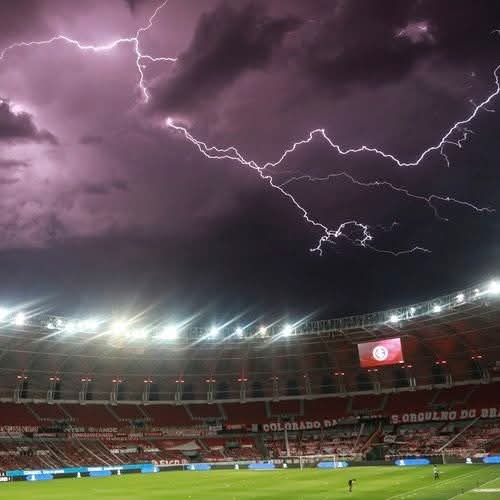
With the 2026 FIFA World Cup just days away, a growing concern is emerging that has nothing to do with tactics, team selection, or refereeing decisions — it is the weather. A widely reported investigation by The Athletic has drawn urgent attention to a specific U.S. safety protocol around lightning strikes that could cause World Cup matches to be suspended for several hours at a time, with no guaranteed endpoint for resumption. The combination of America's strict thunderstorm regulations and FIFA's own absence of a match-abandonment time limit is creating a scenario that tournament organizers, players, and broadcasters are now taking very seriously.
Key Facts at a Glance
- What: U.S. lightning safety protocol mandates immediate match suspension when lightning is detected within 8 miles (approximately 13 km) of a stadium
- The rule: A mandatory 30-minute countdown must pass without further lightning activity before play can resume — and the clock resets with every new strike
- The gap: FIFA has no fixed time limit after which a suspended match is formally called off
- Already happened: During the 2025 FIFA Club World Cup, Chelsea's match against Benfica was suspended for nearly two hours due to thunderstorms
- Concern: With the World Cup spanning peak North American thunderstorm season, the scenario could repeat — at scale
The Protocol Explained: How Lightning Stops a World Cup Match
Under strict U.S. safety regulations, any match must be suspended immediately if lightning or electrical activity is detected within an eight-mile radius of the venue. Once play is stopped, a mandatory 30-minute countdown begins before a match can restart. The complication arises when another lightning strike is detected during that waiting period — in those situations, the 30-minute timer is reset back to zero, meaning matches can remain suspended indefinitely until there has been a full 30-minute period without any nearby lightning activity. [World Soccer Talk]
This is not a rule FIFA imposed. It is a local safety law that applies to all outdoor events held in the United States, and one that FIFA cannot override. Although FIFA does not have the authority to override local air safety laws in the United States, it also does not set a fixed timeframe for canceling matches — each case is handled individually according to the specific circumstances. [Voice Of Emirates]
That absence of a hard cut-off is precisely what makes the situation so unpredictable. In theory, if thunderstorms repeatedly pass through an area, a match could be paused and restarted multiple times over many hours, or remain suspended for the duration of the storm activity with no defined endpoint.
Unlike rain, which rarely causes soccer matches to be suspended, the mere detection of nearby lightning is enough to bring proceedings to a halt regardless of conditions inside the stadium. [Yahoo Sports] A perfectly dry pitch in a covered or partially covered arena offers no protection from the protocol — it is the proximity of the electrical activity, not its direct impact on the venue, that triggers the suspension.
It Has Already Happened: The Club World Cup Warning
This is not a hypothetical risk. It played out in vivid and chaotic fashion during the 2025 FIFA Club World Cup, which was also held across U.S. venues — serving as a direct dress rehearsal for the 2026 tournament.
Chelsea head coach Enzo Maresca was left furious just before his team's Club World Cup match against Benfica. The match, held at Bank of America Stadium in Charlotte, was delayed for two hours due to lightning and took nearly five hours to complete. With just four minutes remaining in regulation time, fans were asked to evacuate the seating bowl due to safety concerns. That marked the sixth weather-related delay in the first 50 matches of the tournament — despite no rainfall at the venue. [gulfnews]
During that Club World Cup clash, eventual champions Chelsea saw their round of 16 match against Benfica suspended for nearly two hours due to severe weather in the area. [Yahoo Sports] The drama was compounded by the timing: the delay occurred with the match nearly complete, forcing players back to the dressing room, resetting the physical and mental preparation of both sides, and pushing the game well into the night.
Maresca's reaction was direct: "If they are already suspending six, seven, eight games, probably there is something that is not working well," he said, adding that the United States "is not the right place to do this competition." [gulfnews] His comments reflected a frustration shared widely within the footballing world — and one that now looms over the much larger, far more globally prominent 2026 World Cup.
Heat: The Second Weather Threat
Lightning is not the only meteorological challenge facing the tournament. Global players' union FIFPRO has raised concerns over the effect of intense heat during the FIFA Club World Cup in the United States, stating that two games — PSG vs. Atlético Madrid and Chelsea vs. Esperance — should have been postponed due to temperatures exceeding their maximum recommended threshold. FIFPRO medical director Dr. Vincent Gouttebarge confirmed that his organization's position is that matches should be postponed when the Wet Bulb Globe Temperature exceeds 28 degrees WBGT, though FIFA's own guideline limit is set higher at 32 degrees. [ESPN]
The World Cup will be played across host cities that include Miami, Dallas, Houston, Atlanta, and New York/New Jersey — all locations that experience intense summer heat and, in several cases, frequent afternoon and evening thunderstorm activity during the June–July period. Tournament organizers have reportedly responded to the heat concern by scheduling most matches for evening kickoffs and mandating cooling breaks during play. But lightning is harder to schedule around.
FIFA's Challenge: Safety vs. Schedule
The 2026 FIFA World Cup features 104 matches across 48 teams — the most expansive World Cup ever staged. The match schedule is tightly structured, with group stage fixtures running in rapid succession and knockout rounds leaving little room for rescheduling. Players, spectators, broadcasters, and tournament organizers are all beginning to worry that matches featuring some of the world's top national teams may be delayed for long periods of time. [World Soccer Talk]
FIFA has repeatedly stressed that safety remains the priority. However, the governing body has also acknowledged that extreme weather could become one of the biggest operational challenges during the tournament. [World Soccer Talk]
The scenario that concerns officials most is a high-stakes knockout match — a quarterfinal or semifinal, perhaps — suspended deep into the evening by a persistent thunderstorm, with broadcasters, global audiences of hundreds of millions, and both teams caught in enforced limbo, unable to resume until the storm fully clears.
What Happens Next
The World Cup kicks off on June 11, 2026, with Mexico hosting South Africa at Estadio Azteca in Mexico City — a venue in a city with a different climate profile from the U.S. host cities. However, the majority of matches, including the final at MetLife Stadium in New Jersey on July 19, will be played across American venues fully subject to U.S. thunderstorm protocols.
FIFA has not announced any new emergency regulations or contingency plans specific to lightning delays ahead of the tournament. Fans attending matches in U.S. stadiums are advised to be aware of the protocol and to follow official stadium instructions promptly in the event of a suspension.
Conclusion
The 2026 FIFA World Cup arrives carrying extraordinary promise — a record 48 teams, a North American stage, and projected global audiences of over a billion viewers. But the tournament also arrives with a weather-related wildcard that no tactical planning or footballing genius can control. The U.S. lightning safety protocol, combined with FIFA's lack of a match abandonment threshold, creates genuine potential for multi-hour suspensions at any point during the tournament. With the 2025 Club World Cup already providing a stark preview of what such disruptions look like in practice, this is a challenge that will require careful management — and perhaps a measure of good fortune with the weather — from the very first whistle.
CM NEWS | Sports | FIFA World Cup 2026
Source reporting: The Athletic | Additional context: FIFPRO, Gulf News, Yahoo Sports