Politics
Ethiopia Heads to the Polls Monday: What You Need to Know About the 7th General Election
More than 54 million registered voters, 52,000 polling stations, and 47 political parties — but questions over fairness, regional conflict, and opposition access cloud one of Africa's most significant votes of 2026.
By CM News Staff · Published May 31, 2026 · 6 min read
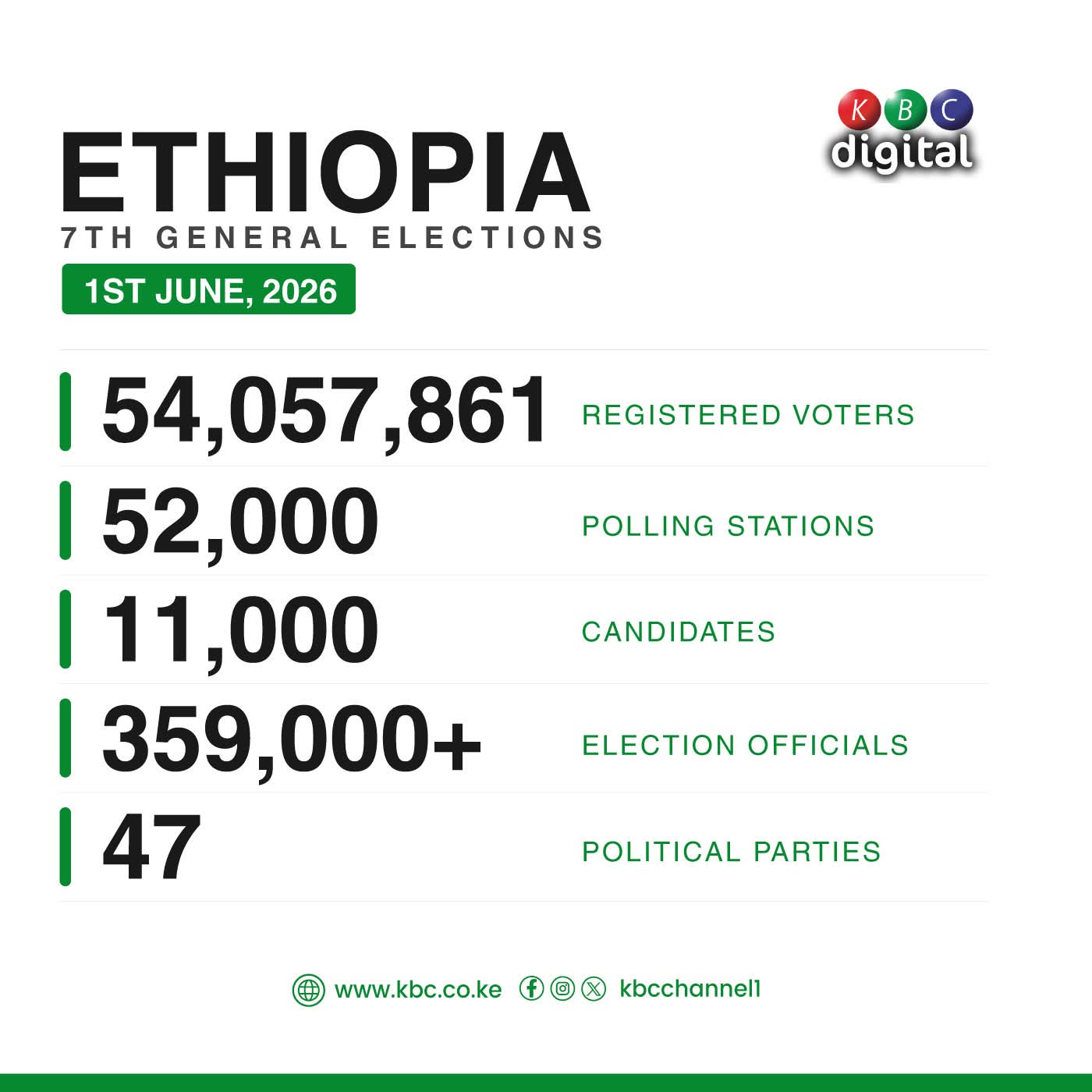
Ethiopia goes to the polls on Monday, June 1, 2026, for its seventh general election — a vote that will determine who governs Africa's second most populous nation for the next five years. The scale of the exercise is enormous: more than 54 million registered voters are expected to cast ballots across approximately 52,000 polling stations, with over 359,000 election officials deployed nationwide and 11,000 candidates representing 47 political parties competing for parliamentary seats.
The election is being closely watched across the continent and internationally — not only because of Ethiopia's regional weight in the Horn of Africa, but because of serious questions about how free, fair, and inclusive the process will be.
The Key Players and What Is at Stake
Prime Minister Abiy Ahmed's governing Prosperity Party is widely expected to secure a decisive victory. [Al Jazeera] Abiy has led Ethiopia since 2018, initially earning broad praise — and the Nobel Peace Prize — for releasing political prisoners, opening civic space, and normalizing relations with neighboring Eritrea after two decades of hostility.
At the last general election in 2021, the Prosperity Party won 485 of the 502 contested seats — a near-total sweep of parliament. [Africanews] That vote was itself held against the backdrop of a devastating civil war in the Tigray region that would go on to claim an estimated 600,000 lives before the Pretoria peace agreement was signed in 2022.
The incumbent now faces more than 45 opposition parties contesting the election, though the Prosperity Party controls most federal and regional state institutions. [The Conversation] Among the opposition parties on the ballot are the Ethiopian Citizens for Social Justice, the National Movement of Amhara, the Enat Party, the Freedom and Equality Party, and the Oromo Federalist Congress — none of which analysts consider capable of mounting a serious national challenge to the ruling party.
The Scale of the Operation
The logistics of conducting an election in a country of over 130 million people across highly diverse terrain are formidable. Voting is scheduled to run from 6:00 a.m. to 6:00 p.m. local time on June 1, with the National Election Board of Ethiopia having established more than 52,000 polling stations and deployed nearly 200,000 election workers and officials for election-day operations. [Geeska]
Voter registration, which ran from March 7 to April 22, 2026, used both digital and in-person systems. More than 5.5 million voters registered digitally through dedicated apps developed by the NEBE, while the remainder registered manually at polling stations. [Geeska]
The gender breakdown of the registered electorate is approximately 54% male and 46% female, according to election board data.
Serious Concerns: Conflict, Press Freedom, and Opposition Access
Despite the logistical scale of the exercise, multiple credible international organizations have raised significant concerns about the conditions under which the election is taking place.
The Prosperity Party is running completely uncontested in 64 of Ethiopia's 547 constituencies. No voting will take place in the northern Tigray region, where tensions between the federal government and the Tigray People's Liberation Front remain unresolved following the 2020–2022 civil war. [Africanews]
In the capital, Addis Ababa, the ruling party closed major roads including Meskel Square to stage large campaign rallies, while opposition parties reported being barred from holding comparable gatherings. [Al Jazeera]
The security situation in several regions poses additional concerns. In the Amhara region, federal forces have been fighting the ethnic nationalist Fano militia, which has openly rejected the election. Fighting, arrests, and military operations have continued across parts of the region, with reports of air and drone strikes by federal forces raising fears that insecurity could prevent many communities from participating. [Geeska]
On press freedom, the picture is similarly troubling. Ethiopia ranked 145th out of 180 countries in the 2025 Reporters Without Borders Press Freedom Index. Eight journalists are currently imprisoned, and in February 2026, authorities revoked the accreditation of Reuters journalists following a critical investigative report. [OMCT]
At the 61st session of the UN Human Rights Council in March 2026, 41 countries issued a joint statement warning that full respect for civil and political rights and a free civil society and media environment are preconditions for free and fair elections, urging Ethiopia to reverse what they described as a negative trend. [OMCT]
A Test of Legitimacy, Not Just an Election
Analysts have framed the 2026 election as an important test of Ethiopia's institutional resilience. The central question is not only whether the Prosperity Party will retain its dominant position, but whether the electoral process can provide a credible mechanism for political inclusion in a country where authority, identity, and territorial governance remain contested. [ISPI]
Low-key campaigning has defined the pre-election period, with the Prosperity Party holding only one major rally in the capital. Online debates between candidates have attracted only a few hundred views, and the absence of visible campaign materials has been widely noted. [Africanews]
Ethiopia's economic circumstances add further complexity. The country has recorded strong GDP growth in recent years — supported by major infrastructure projects including the Grand Ethiopian Renaissance Dam — but inflation and foreign currency shortages have created hardship for ordinary citizens, particularly in urban areas.
Opposition parties enter the election divided and weakened, with some claiming they face politically motivated administrative barriers to participation. The Prosperity Party's near-total dominance of state institutions gives it a structural advantage that critics argue makes competitive elections structurally difficult to achieve. [Africanews]
What Happens Next
Results from the June 1 vote are not expected immediately. Ethiopia's National Election Board will oversee the counting process at the constituency level before announcing official results in the days following polling day.
If, as widely anticipated, the Prosperity Party secures another commanding majority, Abiy Ahmed will be confirmed for a further term as prime minister. The composition of the new parliament — and whether any opposition parties secure meaningful representation — will be a key indicator of the election's credibility in the eyes of domestic and international observers.
International observers from the African Union, IGAD, and other bodies are present in country. Their assessments, expected in the days following the vote, will carry significant weight for Ethiopia's international relationships and its access to development financing.
The longer-term question — whether Ethiopia's multi-ethnic federal system can accommodate the political tensions that have defined the past decade — will not be answered by the vote itself. But the election's conduct and outcome will shape the environment in which those tensions are managed for years to come.
Conclusion
Ethiopia's 7th General Election represents one of the most consequential votes in the Horn of Africa in 2026. The scale of the logistical operation — over 54 million registered voters, 52,000 polling stations, and 47 competing parties — reflects a country of extraordinary complexity. The conditions under which it is being held, marked by regional conflict, restricted civic space, and a fragmented opposition, will determine how the international community and Ethiopians themselves assess its legitimacy. Results are expected in the days following June 1.
CM NEWS · CelebSamMedia.com · Independent Global News Reporting