Sports
2026 FIFA World Cup Sees Early Surge in Red Cards as Tournament Nears Recent Records After Just Two Matches
Three red cards in the opening two matches have already pushed the 2026 FIFA World Cup close to the total number of dismissals recorded across the entire 2018 and 2022 tournaments.
By CM NEWS Sports Desk
Publication Date: June 12, 2026
Introduction
The 2026 FIFA World Cup has made an explosive start, with three red cards issued in the tournament's opening two matches. While the competition is still in its infancy, the number of player dismissals has already placed the tournament within touching distance of matching the total red card count from both the 2018 and 2022 World Cups.
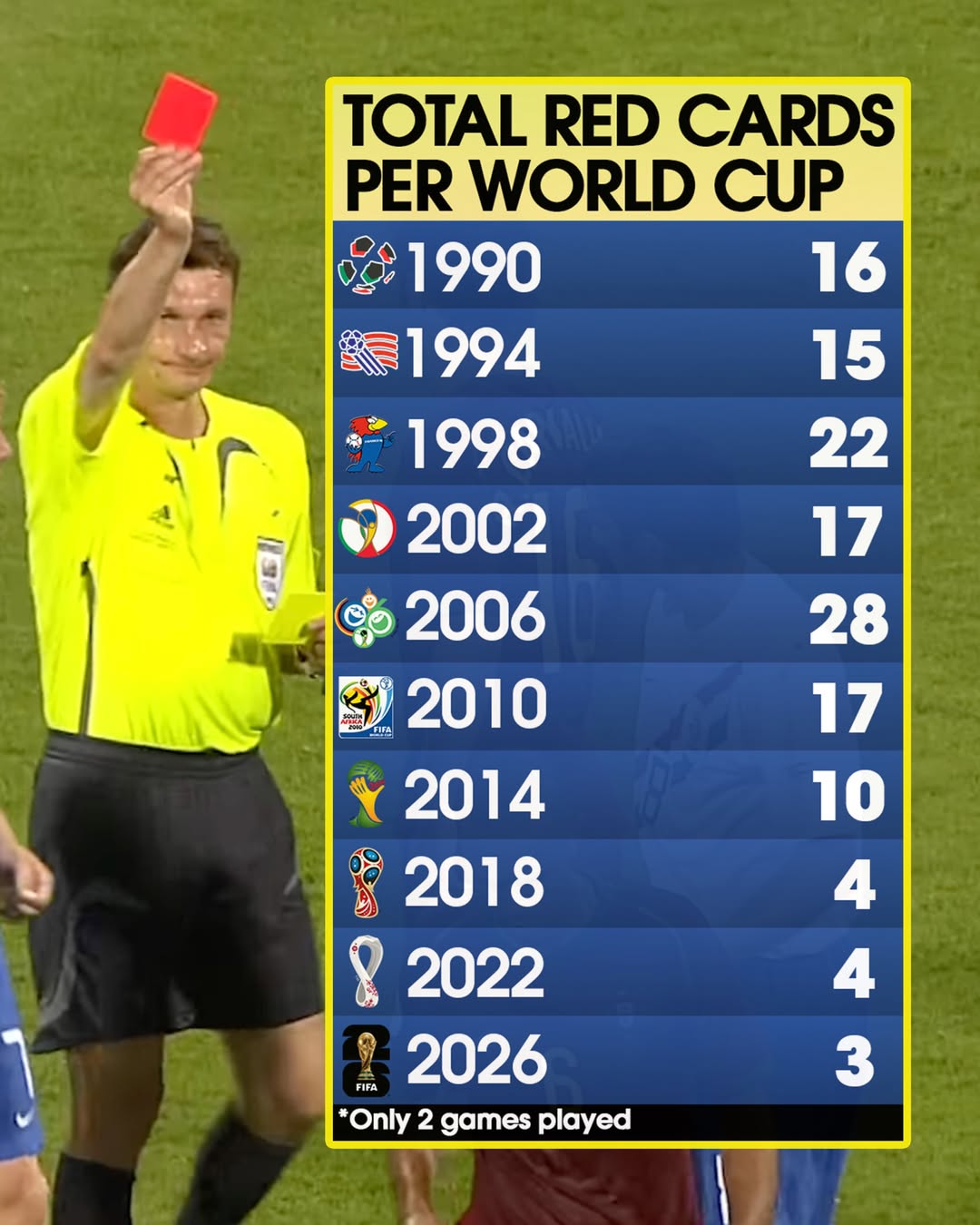
According to statistics shared by football media outlet Men in Blazers, the entire 2018 FIFA World Cup in Russia and the 2022 FIFA World Cup in Qatar each produced only four red cards. With the 2026 edition already recording three expulsions after just two games, discussions have emerged about whether the tournament could become one of the most disciplinary-heavy World Cups in modern history.
Key Facts
2026 FIFA World Cup red cards so far: 3
Matches played: 2
Total red cards in 2018 World Cup: 4
Total red cards in 2022 World Cup: 4
Record number of World Cup red cards: 28 (Germany 2006)
Famous disciplinary match: Portugal vs Netherlands in 2006, known as the "Battle of Nuremberg"
Full Story
The opening stages of the 2026 FIFA World Cup have already generated headlines for more than just goals and results. Referees have been forced into major disciplinary decisions, producing three red cards in the tournament's first two fixtures.
This early trend stands in stark contrast to recent World Cup editions, where dismissals were relatively rare. During the 2018 tournament in Russia, only four players were sent off throughout the entire competition. The same total was recorded at the 2022 World Cup in Qatar despite both tournaments featuring dozens of matches and hundreds of players.
As a result, the current pace of red cards in 2026 has attracted significant attention from football analysts, former referees, and supporters around the world.
While it remains far too early to predict the final disciplinary tally, the statistics highlight a notable shift in the tournament's opening atmosphere. Players appear to be competing with high intensity, and officials have shown a willingness to enforce the Laws of the Game strictly when necessary.
The increase may also reflect evolving refereeing standards and FIFA's continued emphasis on player safety. Modern football places greater scrutiny on dangerous tackles, violent conduct, and actions that could endanger opponents.
Historical World Cup Red Card Trends
A look at previous tournaments reveals how dramatically disciplinary records have changed over time.
World Cup Red Cards
1990 16
1994 15
1998 22
2002 17
2006 28
2010 17
2014 10
2018 4
2022 4
2026* 3
After only two matches.
The data shows a clear decline in red cards over the past two decades. Following the record-setting 28 dismissals at the 2006 World Cup, FIFA and football governing bodies introduced various measures aimed at improving player discipline and reducing reckless challenges.
Video Assistant Referee (VAR) technology, introduced at the World Cup in 2018, has also played a role in helping officials make more accurate disciplinary decisions while discouraging certain forms of misconduct.
Background: The Infamous Battle of Nuremberg
Whenever discussions turn to World Cup red cards, the 2006 Round of 16 match between Portugal and the Netherlands inevitably enters the conversation.
Nicknamed the "Battle of Nuremberg," the encounter remains one of the most heated matches in World Cup history. Russian referee Valentin Ivanov issued an astonishing four red cards and sixteen yellow cards during the game.
The match became a symbol of extreme on-field tension and remains a benchmark for disciplinary records at FIFA tournaments.
The 2006 World Cup ultimately produced 28 red cards, a figure that still stands as the highest in tournament history.
Analysis: Why Are Red Cards Increasing Early in 2026?
Several factors may explain the spike in dismissals during the opening matches.
1. Higher Intensity and Pressure
The expanded tournament format means more nations are participating and many teams are making historic appearances on football's biggest stage. Players may be approaching matches with greater urgency and emotion.
2. Strict Refereeing Standards
FIFA has consistently instructed match officials to prioritize player safety. Dangerous tackles, off-the-ball incidents, and violent conduct are more likely to receive severe punishment than in previous eras.
3. VAR Influence
Although VAR was initially expected to reduce controversial red cards, it has also increased the likelihood that serious offenses are identified and punished correctly.
4. Tactical Fouling
Modern football's tactical demands sometimes encourage players to commit professional fouls to stop dangerous attacks. When such incidents deny clear goal-scoring opportunities or involve excessive force, red cards often follow.
What Happens Next?
With dozens of group-stage matches still to be played, the 2026 FIFA World Cup remains far from establishing any disciplinary records.
However, if the current trend continues, the tournament could surpass the four-red-card totals recorded in both 2018 and 2022 within the next round of fixtures.
Football observers will be watching closely to determine whether the opening dismissals were isolated incidents or an indication of a more aggressive and intensely contested tournament.
For referees, maintaining consistency will be crucial as the competition progresses and the stakes become even higher.
Conclusion
The 2026 FIFA World Cup has already generated discussion for its unusually high number of red cards at such an early stage. With three dismissals recorded after only two matches, the tournament is already approaching the total red card counts seen across the entirety of the 2018 and 2022 World Cups.
While it remains far below the all-time record of 28 red cards set in 2006, the early figures suggest discipline could become one of the defining storylines of this year's competition. As more matches are played and tensions rise, football fans around the world will be watching to see whether the trend continues or levels off as the tournament unfolds.